Thursday, September 1, 2016

2 Reasons Many Ministries Are Not on the Path of True Life by BERT FARIAS


I'm not saying that the entire Church falls in this category, but the general impression of this minister was that the American Church was working much by its own might and power and not by the Spirit of the Lord.
I'm not saying that the entire Church falls in this category, but the general impression of this minister was that the American Church was working much by its own might and power and not by the Spirit of the Lord. (astrid westvang/Flickr/Creative Commons)

On a recent international ministry trip the word of the Lord came unto me saying: "The answer for the healing of this nation is in the pure rivers of living water that flow from man's heart." He then began to give me understanding as to why those rivers have been muddied and are no longer pure.

Of course, the river or rivers represent the flow of God's Spirit and power in the Earth. He referred me to the ever-enlarging river in Ezekiel 47 and the one in Revelation that was pure and clear as crystal (Rev. 22:1). God's will is for the river's waters to be pure with an ever-increasing width and depth to them. He showed me that the waters of that river were once pure in Jesus' ministry and in the early church, but then gradually men contaminated and defiled those waters. The Lord gave me two primary reasons those once pure waters have been muddied and polluted in much of the body of Christ:

1. The first reason is that men do not follow God's wisdom and plan for their lives and ministries. They follow the wisdom of men, which is often smart, creative and glittering in man's sight. They also follow their own plans, which usually appeal to the logic and natural goodness of man. In other words, man's plans seem good, but may not be God at all.

What happens is that men form their own plans and ask God to bless them instead of waiting on the Lord for His plans, which are already blessed. There's a big difference between the two.

"Except the Lord build the house, those who build labor in vain..." (Ps. 127:1).

"Then Jesus said to them, 'Truly, truly I say to you, the Son can do nothing of Himself, but what He sees the Father do. For whatever He does, likewise the Son does'" (John 5:19).

The greatest life and power is manifest in moving in God's wisdom and plan. The problem today is that men are doing all the moving. One foreign minister, after scoping the landscape of Christianity in America and visiting some of the great churches here, spoke these compelling words, when asked what impressed him the most.

"How much the church here has been able to do without God."  Ouch!

I'm not saying that the entire church falls in this category, but the general impression of this minister was that the American church was working much by its own might and power and not by the Spirit of the Lord.

Do you understand that it was unthinkable to Jesus to attempt ministry without the direction of the Holy Spirit? Just as it is unthinkable for a man to produce a baby without a woman, so it was unthinkable for Jesus to minister without the co-laboring of the Holy Spirit.

Jesus understood that He was not on the earth to do His own will but the will of the Father. He also understood that He was not here to do His own will in the name of the Father, which is the common error of today.

Here's the bottom line: The number one problem we have in Christianity today and the reason for every failure among those who claim His Name is we don't know Him.

We are not talking about a general knowledge of Him. Of course, when we are born again we come into new life in Jesus and we know Him as our Savior. Thank God that we receive eternal life and an assurance of our salvation. But to intimately know Him will move us into another realm of the Spirit's operation in our lives. You know Him through His Word and His Spirit and an ever increasing intimate knowledge of His heart and ways.

The first step toward knowing God intimately is to surrender the life of Christ within you on the altar of the Father's will. The reverse is what most Christians do. They sacrifice the life of Christ within them on the altar of their own will. They have life in their spirits but the direction of their lives comes from their own will and carnal mind resulting in works of the flesh.

This same pattern is also true in ministry today. Thus the reason the works of man are plentiful while the true works of the Father are rare.

2. The second reason the Lord gave me for the muddying of those waters was that love for people has been replaced with lust for ministry. Religious activity has often been disconnected from the genuine love of God and meeting the real needs of people.

 We have our programs, our projects, our forms, our feasts, our religious activities, and although these things can be useful and have their place, if we're not careful, our motivation for these things can be done for the wrong reasons. Our motives can become impure and defiled. What make the rivers of living water pure is also our motives.

 Jesus taught us that when we pray, fast and give we should do it unto the Father and not to be seen by men—not for the recognition and honor of men but for the honor of God (Matt. 6).

 Listen to this scathing rebuke of how disconnected Israel's religious activities had become from the heart of God:

"Hear the word of the Lord, you rulers of Sodom; listen to the law of our God, you people of Gomorrah: For what purpose is the multitude of your sacrifices to Me? says the Lord. I am full of the burnt offerings of rams, and the fat of fed animals. I do not delight in the blood of bulls, or of lambs, or of male goats. When you come to appear before Me, who has required this at your hand, to trample My courts? Bring no more vain offerings; incense is an abomination to Me.

"New Moons, Sabbaths, and convocations— I cannot bear with evil assemblies. My soul hates your New Moons and your appointed feasts; they are a burden to Me; I am weary of bearing them. When you reach out your hands, I will hide My eyes from you; even when you make many prayers, I will not hear. Your hands are full of blood.

"Wash yourselves, make yourselves clean; put away the evil from your deeds, from before My eyes. Cease to do evil, learn to do good; seek justice, relieve the oppressed; judge the fatherless, plead for the widow" (Is. 1:10-17).

We have the same situation today in much of the church today. The entrapments in church work and ministry are many. We are often seduced by the production and pride of man, the professionalism and politics of the ministry, and all the hype and Hollywood-like appearance that is too often associated with ministry.

We must unplug ourselves from the entrapments of appearances that can fool us, and in fact, often act as a smokescreen to hide what is really going on. The above reproof by the Lord bears this out.

Secondly, we must plug ourselves in to meeting the real needs of people at a grassroots level. Every time we gather together in our church services, there are people that sit to our right and left that have very pressing issues in their lives, from single mothers trying to raise kids on their own to those who cannot pay their rent and struggle under heavy financial burdens. Then there are those who have deep relational issues in strife-filled homes, and marital situations that are on the brink of separation and divorce. The elderly among us have their own unique needs that are very difficult. These types of situations are void of the hype, excitement, and glamour that church services and Western Christianity often portray.

And although we have a responsibility to make sure the needs of the saints are met, the real work happens out in our communities. This is where our character is tested and where our sacrifice and self-denial is put to the fire. When we allow the love and compassion of Jesus to rule our hearts, we will find ourselves moving closer and closer to these types of needs and people that are often forgotten in our churches and in society. When we move in this kind of purity of heart, we will see the rivers of living water rise and the favor and power of God increase in our lives and churches.

What have you done with the eternal life of Christ that is in you? Once again, the majority of the Christian world has sacrificed that life on the altar of their carnal mind and their own will. Many have never yielded that life and love within them to the Lordship of Jesus, and the Spirit's direction.

The word of the hour for the body of Christ is that ministers and believers would learn to commune with the Holy Spirit and minister to the Lord until they hear and know the mind of Christ and plans of God for their lives, situations and ministry, and until they start moving in the love and compassion of His great heart.

Bert M. Farias, revivalist and founder of Holy Fire Ministries, has authored several books with an emphasis on helping to restore the true spirit of Christianity in the Church today, including the newly released, Passing on The Move of God to The Next Generation. An anointing of fire marks his ministry with frequent demonstrations of the Spirit and power of God. He ministers interdenominational and cross-culturally in nations, churches, conferences, on the streets and in homes. He and his wife Carolyn also host The Holy Ghost Forum – a school of the Spirit. Follow him at Bert Farias and Holy Fire Ministries on Facebook and @Bertfarias1on Twitter.

How to Avoid Self Deception in Your Walk With Christ by SHAWN A. AKERS

Sometimes you need to be honest with yourself. Jesus knows your heart.
Sometimes you need to be honest with yourself. Jesus knows your heart. (iStock photo)

For most of my adult I life, I believed James 1:22-25 didn't apply to me. I had convinced myself that I was a "doer" of God's Word and not simply a "hearer."

After all, I went to church. I tithed. I listened to well-known preachers and agreed with what they said. Here and there, I told people about Jesus.

Wow, did I buy into Satan's lies. And he did a fantastic job of selling it, too.

Over the past year of my transformation as a believer, however, I slowly began to realize that I was the epitome of James 1:22, which says, "Be doers of the word and not hearers only, deceiving yourselves. For if anyone is a hearer of the word and not a doer, he is like a man observing his natural face in a mirror; for he observes himself, goes away and immediately forgets what kind of man he was. But he who looks into the perfect law of liberty and continues in it, and is not a forgetful hearer but a doer of the work, this one will be blessed in what he does" (MEV).

Every Sunday I would hear a good sermon at church, and every Sunday it would be the same. I got fired up and knew I was going to have a great week after being filled with a good word and great fellowship. But then something would happen in traffic or my children would say something that shouldn't have upset me but did, or I would worry about our family finances, and my joy would dissipate.

Immediately, I had forgotten what kind of man I was. I was a "hearer" of the Word and not a "doer." Immediately, I had become exactly like the sower in Matthew 13:20-22, "But he who received the seed on rocky ground is he who hears the word and immediately receives it with joy, yet he has no root in himself, but endures for a while. For when tribulation or persecution arises because of the word, eventually he falls away. He also who received seed among the thorns is he who hears the word, but the cares of this world and the deceitfulness of riches choke the word, and he becomes unfruitful" (MEV).

As a believer in Jesus Christ, you've heard the good news of the gospel. Most know of God's promises of provision and protection, and most know they have the ultimate victory in Jesus. Yet when trials and tribulation come, and they deceive themselves into believing that God doesn't really care for them. They deceive themselves by thinking he's distant and isn't listening to their problems. The word is choked from them as the weeds have grown among the good seeds that were planted.

In other words, if I hear the word of God but do not do what it says, I am treating the Word as if it were useless. I am deceiving myself about the very nature and purpose of the Word of God.

"... for the hearers of the law are not justified before God, but the doers of the law will be justified" (Rom. 2:13, MEV).

So what can you do to make sure this doesn't happen to you, that you don't become a "hearer" only and deceive yourself?

* Realize that trials WILL come in this life, and let your faith be tested, because it produces patience (James 1:3-4). It's all part of the growing process.

* Get connected with a small group at church. I'm not saying that you can trust everyone, but find people within that small group to discuss your life issues—people with whom you can be transparent and vulnerable.

* Pray that God will teach you how to be a "doer" of His Word and not simply a "hearer." Pray that you will know better than to deceive yourself. 

* Adhere to Proverbs 3:5-6 and trust God "with all your heart and lean not unto your own understanding." Don't be one of those nominal Christians who simply won't allow that.

* Continually seek wisdom. Don't just read your Bible every day, study it. Realize that the Bible reveals God's wisdom to us (Prov. 2:10).

* When you make sinful or mistaken choices, learn from them, repent and recover. God will be right there with you. 

Rather than be the sower from Matthew 13:19-22, don't you want to be the sower from verse 23? "He who received seed on the good ground is he who hears the word and understands it, who indeed bears fruit. Some produce a hundred, sixty, or thirty times what was sown" (MEV).

Bearing fruit is what your walk with Christ is all about. It's all about being a "doer." 

And as I always like to say, "there is that." 

3 Reasons Why you should read Life in the Spirit. 1) Get to know the Holy Spirit. 2) Learn to enter God's presence 3) Hear God's voice clearly! Go deeper!


Has God called you to be a leader? Ministry Today magazine is the source that Christian leaders who want to serve with passion and purpose turn to. Subscribe now and receive a free leadership book.

Tuesday, August 16, 2016


Monday, August 1, 2016

What Is That? Could This Bizarre Winged Creature Be a Fairy, an Alien or a Locust From the Book of Revelation?


I wasn't going to write about this. I was trained as an attorney and I am skeptical by nature, and so I generally don't like to write about things that I can't prove. But in the case of this bizarre winged creature, a couple of factors changed my mind. First of all, we actually have physical evidence which has been scientifically tested. When it comes to things like this, people are always crying out for some real physical evidence, and now we have some. Of course the existence of evidence does not mean that we can necessarily find answers to all of our questions, but at least we have something to work with. Secondly, a highly respected researcher named L.A. Marzulli spent a great deal of time extensively investigating this case. I have personally interacted with L.A. Marzulli, and I have followed his work for years, and so I know how credible he is.

Earlier today, I visited L.A. Marzulli's blog, and I was astounded by what I saw. There in living color was a bizarre winged creature that doesn't bear any resemblance to any animal that science currently knows about. You can view it for yourself on his blog right here.

L.A. Marzulli did not personally discover this creature. Rather, it was originally discovered on the side of a highway by a 13-year-old Mexican boy who didn't know what it was. He ultimately turned it over to a well-known Mexican investigative journalist named Jaime Maussan. Since that time this creature has been x-rayed, and the x-rays enabled researchers to see that the creature possessed a full skeletal structure. The x-rays even showed that the creature's left leg had been broken at one point. In addition, DNA testing was done, and the DNA did not match any known animal.

This amazing discovery is featured in L.A.'s new documentary entitled "Watchers 10", and a nine-minute clip featuring analysis of this creature has been posted to YouTube right here. So the big question that we need to ask is this:

What in the world is that thing?

At this point, there appear to be three main theories.

Many people are calling this winged creature a fairy. These days a lot of people out there believe in "fairies", and YouTube is loaded with footage that people have supposedly captured of "fairies" flying around outside at high speed. Videos are very easily doctored, and the hard evidence that these "fairies" exist has always seemed to be lacking. And this winged creature doesn't appear to fit the bill anyway. This winged creature is certainly small, and it certainly does have wings, but it doesn't really fit the description of what you might expect a "fairy" to look like. Instead, it looks quite gruesome and evil. It has pointy ears like a gargoyle, and the body of the creature looks to me like it resembles an insect more than a person.

Secondly, some people are calling this winged creature an "alien". But of course that label is almost instantly applied to any strange creature that pops up these days.

The most common form of "alien" that people encounter is known as "the greys," but there is only a slight resemblance between this creature and "the greys". From what people have reported, "greys" don't have long pointy ears, they don't have wings, and they don't have tails.

Of course it is always possible that this creature could be another type of "alien" or demonic entity. But I don't know we could conclusively prove that.

Thirdly, L.A. Marzulli and others have pointed out that this winged creature that was discovered in Mexico does seem to have some similarities to the "locusts" that are described in Revelation chapter 9. The following is what Revelation 9:7-11 says in the Modern English Version...

The shape of the locusts was like horses prepared for battle. On their heads were something like crowns of gold, and their faces were like faces of men. They had hair like the hair of women, and their teeth were like the teeth of lions. They had breastplates like breastplates of iron, and the sound of their wings was like the sound of chariots with many horses running to battle. They had tails like scorpions and stings in their tails. Their power was to hurt men for five months. They had as king over them the angel of the bottomless pit, whose name in Hebrew is Abaddon, and in Greek his name is Apollyon.

Does this creature have a face like a man?

I think that you could say that.

I don't see any hair, but it is always possible that it could have had hair at one time. I do see some frightening looking teeth, and it definitely has very prominent wings.

The detail that is most intriguing though is the stinger at the end of the tail. On Marzulli's website, you can see a close-up of the tail and the stinger. Obviously the stinger has a function, and at this point we can only speculate because we don't know enough about the creature.

Ultimately, there is always the possibility that this could be some sort of an elaborate hoax, but the scientific examinations that have been done so far have cast doubt on that explanation. But I am certainly not willing to totally rule that out at this point either.

In the end, I don't know what that creature is.

I was highly intrigued when I saw it, and after thinking about it I decided to share this bit of news with all of you.

I would encourage you to look into this for yourself and come to your own conclusions.

If we are indeed living in the last days as described in the Bible, then our world is going to get very, very weird in the years ahead. The book of Revelation describes all sorts of bizarre creatures and strange events, and the more I read it the more I am convinced that the period just before Jesus comes back is going to look a whole lot more like an extremely wild science fiction movie than most people would dare to imagine.

So yes, a strange winged creature that looks like something from another world may be hard to swallow, but this might just be the tip of the iceberg.

By the time it is all said and done, we could very well see things in the years ahead that will completely blow all of our minds.

Michael Snyder is the founder and publisher of End Of The American Dream. 

Since God Hates the Shedding of Innocent Blood, Can a Christian Vote for Hillary?

by Dr Michael Brown

Democratic presidential nominee Hillary Clinton addresses the Democratic National Convention via a live video feed from New York during the second night at the Democratic National Convention in Philadelphia, Pennsylvania

There are few sins God hates as much as shedding innocent blood, especially the blood of children. Seeing that Hillary Clinton is a radically pro-abortion candidate and seeing that the Democratic platform reinforces those radical views, can a Christian vote for Hillary in good conscience?

In Jeremiah 19, God explained why the people of Judah were about to go into exile: It was because they worshiped idols and because they "filled this place [speaking of Jerusalem] with the blood of the innocent, and have built the high places of Baal to burn their sons with fire for burnt offerings to Baal, which I did not command or decree, nor did it come into My mind" (Jer. 19:4-5).

Because of these heinous sins, Jerusalem was destroyed and the Temple of Yahweh burned to the ground, with tens of thousands going into exile.

Does God hate the shedding of innocent blood any less today, especially when it is the blood of children? Listen again to Jeremiah: "They have built the high places of Topheth, which is in the Valley of Ben Hinnom, to burn their sons and their daughters in the fire, which I did not command them, nor did it come into My heart" (Jer. 7:31).

What, exactly, did this entail? Listen to this description from the medieval Jewish commentator Rashi, who explained that the high places of Topheth refer to the god "Molech, which was [made] of copper, and they would heat it up from underneath it with its hands spread out and heated. And they would place the child on his hands, and he would be burnt and moan, and the priests would beat drums so that the father should not hear his son's voice and take pity." What a horror!

Now stop for a moment and look at these images of aborted babies and ask yourself how the Lord must feel about the shedding of this innocent blood—the blood of innocent babies in the womb.

Can you, as a follower of Jesus, cast your vote for a candidate who supports this bloodshed? Can you vote for Hillary Clinton, one of the best friends Planned Parenthood has ever had?

Just look at the stark contrast between the RNC and DNC platforms on abortion.

As reported by LifeNews.com, "The proposed Democratic Party platform this year is more extreme than it has ever been, calling for taxpayer funding of abortion and a repeal of the Hyde Amendment. The Democratic Party platform already supports legalized abortion on demand for any reason up until birth.

"'We will continue to oppose—and seek to overturn—federal and state laws and policies that impede a woman's access to abortion, including by repealing the Hyde Amendment,' it reads."

In complete contrast, the RNC platform on abortion begins with: "Faithful to the 'self-evident' truths enshrined in the Declaration of Independence, we assert the sanctity of human life and affirm that the unborn child has a fundamental individual right to life which cannot be infringed."

The platform supports "a human life amendment to the Constitution and endorse legislation to make clear that the Fourteenth Amendment's protections apply to unborn children." It opposes "using public revenues to promote or perform abortion or fund organizations which perform or advocate it and will not fund or subsidize health care which includes abortion coverage."

It calls for appointing judges who will uphold these values, reaffirms its opposition to partial birth abortion, and salutes "the many States that have passed laws for informed consent, mandatory waiting periods prior to an abortion, and health-protective clinic regulation."

Again, the difference between the two platforms could not be more extreme. It is literally the difference between death and life.

Let's also remember that Hillary Clinton is hardly a pacifist who would avoid the shedding of blood in war (in contrast with allegedly war-mongering Republicans). And even so, there is a world of difference between going to war to defeat terrorism and killing a baby in the womb.

Some have argued that it doesn't matter where a candidate stands on abortion since the laws never really change. After all, we're told, after 20 years of Reagan, Bush, and Bush, Roe v. Wade was still not overturned.

That's true, but one reason is that we also had 16 years of Clinton and Obama. What would have happened if we had 36 years of presidents in the mold of Reagan? What if the progress made under a pro-life president wasn't undone by a pro-abortion president? What if all presidential appointees to the Supreme Court were pro-life during the last 36 years? The answers are self-evident.

And let's not minimize the progress that has been made in different states, including requiring women to view an ultrasound of their baby before aborting. Thank God for every life saved.

The bottom line is this: Can you look at pictures of aborted babies—such as baby Malachi—and read verses about God's hatred of killing children and then vote for a candidate who aggressively defends a woman's "right" to this bloodshed, even into the ninth month?

It's one thing to be uncertain about voting for Trump (or other candidates). It's another thing to vote for a radical, pro-abortion candidate like Hillary Clinton.

I, for one, do not see how you can look Jesus in the eye, look abortion in the eye, and vote for Hillary.

Only God is your judge, and you and I will give ultimate account to Him. But if you're a regular "pro-choice" voter, I urge you to reconsider your ways.

Dr. Michael Brown (www.askdrbrown.org) is the host of the nationally syndicated Line of Fire radio program. His latest book is The Grace Controversy. Connect with him on Facebook or Twitter.

Jentezen Franklin: Donald Trump Rededicated His Life to Christ

Free Chapel's Jentezen Franklin

Free Chapel's Jentezen Franklin says Republican nominee Donald Trump rededicated his life to Christ 10 years ago, according to a report.

Franklin's comments come a few weeks after the Pentecostal preacher joined Trump's Faith Advisory Committee.

"He did say 'I don't wear my religion on a sleeve and I'm not, by any means, a saint,'" Franklin told the Gainesville Times. "But (Trump said), 'What America needs now is not a preacher in the oval office—it needs a leader.'"

Franklin is just the latest evangelical to tout Trump's faith, joining the ranks of men like Dr. James Dobson and women like televangelist Paula White, also known as the "Trump Whisperer."

"He doesn't know our Christianese," White said. "Someone might take a sound bite and say, 'Oh, see? He's not saved,' or, 'He doesn't love God.' That's the furthest thing from the truth."

Franklin says the billionaire businessman told an audience last month he rededicated his life to Christ when he was 60. That was a decade ago.

His words echo the sentiments expressed by many, including Focus on the Family's Dobson.

"I believe God can change the hearts and minds of people and I celebrate when they support principles of righteousness," Dobson says. http://www.charismanews.com/politics/58832-jentezen-franklin-donald-trump-rededicated-his-life-to-christ

Thursday, July 28, 2016

The Dangers of Hierarchy In Christian Organizations by Roger Smalling, D.Min


Hierarchicalism is an organizational structure based on ascending ranks, like a ladder. The military is hierarchical, with generals, colonels, sergeants, on down to privates. Authority is entirely vertical with little or no accountability at the top. Privates cannot hold a general accountable for his actions. Blame is always passed downward.

Large corporations are also structured hierarchies, with CEO’s, vice presidents and department managers, on down to those who stock shelves. Again, authority is always from the top down with no accountability at the top. Lower ranks usually take the blame for the errors of management. Officers within hierarchies do not represent the will of their subordinates.

Biblical government is the opposite, fundamentally simple. Officers serve the people in a representative system.[1] When it comes to the relationship of officers to one another, as in a Presbytery,[2] every member has equal voice and vote. There are no ranks, merely differences in function. If there is blame, it accrues to the group as a whole.

The difference between the two is like a ladder versus a round table. Since the goals and purposes are different, so are their structures.

When Christian organizations mimic the world’s system, the central principles Christ taught tend to be thwarted. People become lost in a maze of bureaucracy as a monolithic machine feeds itself rather than the people. The organization focuses merely on its own existence as though it had intrinsic value.

During many years in ministry, I have had opportunity to closely observe the effects of hierarchicalism in a Christian context.

By mirroring the world’s structures, Christians may unwittingly forget a central aspect of biblical theology, the corrupt nature of man. In a Christian organization the issue is not efficiency, but sanctification.

Dictatorship is the most efficient form of government known to man. That is why dictators are hard to defeat. They dehumanize people, depriving them of the free expression necessary to reflect God’s image. It is the straight line between two points but casualties are strewn along its sides.

To discern the morality of a leadership structure, one should ask what it stimulates… the fallen nature, or the new nature in Christ.

THE PETER PRINCIPLE: Mediocrity and Incompetence

In his classic book, The Peter Principle[3], sociologist John Peters describes how each member of a hierarchy tends to rise to his level of incompetence. As a person performs well at one level, he may be promoted to the next, until he attains a position beyond his abilities. He will remain at this position generating problems for himself and others. Meanwhile, many frustrated, yet gifted people abandon ship. With time, incompetence multiplies until the organization as a whole becomes mediocre.

Good Christian leaders, functioning within an hierarchical system, try to mitigate these negative effects. Their efforts may be laudable, but often end up futile. Human nature, including in Christians, is susceptible to the temptations generated by hierarchy.

Hierarchies tend to stimulate the worst in our fallen nature

Arrogance
Hierarchies provide a platform where one person feels inherently superior to those of lower ranks. “I have a superior rank because I am a superior person.”

Unholy ambition and jealousy
A person sees another in a rank above his and says to himself, “he is no better than I. In fact, I can do his job better. So why shouldn’t I have that rank?”

Dirty politicking
If a person wants a superior rank, he may be tempted to try to pull strings to get it. This is morally questionable and wastes time and energy for productive work.

The Apostle James notes, For where you have envy and selfish ambition, there you find disorder and every evil practice. James 3:16

The term evil practice translates phaulon pragma, literally foul business.[4] Dirty politicking expresses it well.

Blame shifting
Human nature has a tendency to blame a subordinate when something goes wrong. Blame shifting was Adam’s first reaction after the fall. This is a form of moral cowardice.

Imagine a man carrying a load up a ladder. If he drops it, where does it fall? On whoever is beneath, who in turn, dumps it on the one below him. The guy on the very bottom gets the full load.  In a hierarchy, the load is the blame.

Man-pleasing
Since a person’s rank in the hierarchy depends on the good will of the rank above him, this tempts him to focus on pleasing the person above him rather than God.

Loss of competent personnel
According to Dr. Peters in The Peter Principle, hierarchies tend to squeeze out people who question the way things are done, even if they are highly competent.

A hierarchy, like any organism, becomes more focused on perpetuating its own existence than on what it was created to produce. People who rock the boat will be tossed out of that boat. It doesn’t matter if they were among the few doing the rowing.

Disregard of the ordained office and its spiritual authority
I mention this last for emphasis, not because it is least in important. In fact, I consider it the most serious repercussion of authoritarian structures. In a Christian hierarchy, man-made titles or ranks sometimes negate the spiritual authority of biblical ones. The Word of God accords certain rights and privileges to all ordained officers. Hierarchical structures overlook these.

What if you are a leader in an authoritarian Christian hierarchy?
With a little imagination, you can install administrative devices to minimize the damage. Doing so requires a rare moral courage. Why? These strategies require accountability to the people you lead.[5]


Safety devices

Periodic evaluations of your leadership, anonymous and in writing, from the people you lead. This gives subordinates the opportunity to say what they really think and to do it in safety. You will get the truth about your leadership style.

Create an anonymity committee This may consist of two or three people who can receive complaints without revealing the sources. If there are enough complaints about a particular leader, this can be brought to the attention of upper level management before the leader is able to do serious damage. The reason this requires moral courage is because the leader in question might be you.

Tip: Do not insult the intelligence of your subordinates by announcing an open door policy unless they can hold you accountable for what you say or do to them inside the door. [6]

Memos to subordinates about proposed policies asking for their feedback, gives people a sense of participation in the decision process.

Any device that allows you to be vulnerable to your subordinates and accountable for your actions will gain respect and credibility. Ironically, once you have respect and credibility, those devices will likely become unnecessary.

Are you joining a Christian organizacion?
A good way to discern if the organization is authoritarian is to ask them, “In what way can you be made to stand accountable for the way you treat subordinates?” If you get no answer, look elsewhere.

Summary
Authoritarian hierarchicalism is unbiblical for Christian organizations or churches. It stimulates latent tendencies in our fallen nature. Christian leaders should be aware of these tendencies and establish measures to minimize them. This may require an uncommon moral courage and commitment to absolute integrity and accountability to those we lead.

From this article we learn:

  • Authoritarian hierarchicalism is a secular form of organizational structure, antithetical to the leadership principles Christ embodied.
  • Authoritarian hierarchicalism stimulates the worst in human nature, leading to arrogance, selfish ambition, politicking, blame shifting and more.
  • Christian leaders involved in such structures can mitigate the damage by instituting administrative devices to make themselves approachable and accountable to those they lead.


Smalling's articles and essays are available at www.smallings.com

Wednesday, July 27, 2016

Where Does God Exalt the Office of "Preacher"? by Jon Zens


Is it possible that both Protestant and Catholic worship-styles are oblivious to New Testament patterns? Catholicism puts the sacrament on center stage and includes a homily by a priest. For the most part in Protestantism's worship services everything rallies around the sermon, which is delivered from behind a pulpit. Generally, the "office of preacher" has been elevated. Is such exaltation warranted from the Scriptures we claim to be sufficient for all faith and practice?

We claim that the New Testament documents provide God-inspired direction for the New Covenant people of God, just as the Old Testament Scriptures structured life for Israel. But where do these writings ever reveal what has traditionally come to be known as ―the centrality of preaching‖? Where is the "office of preacher" emphasized?

If these traditions cannot be found in the Bible, why do we get our feathers so ruffled when they are questioned? Why is questioning the inordinate focus on one person‘‘s sermon tantamount to challenging motherhood, apple pie, and even God Himself? Please consider with me the following points, and see if some light from the Lord‘‘s Word emerges to drive us to view "church" in a new light.

The "sermon" as traditionally practiced, in which a clergy person usually gives a message from behind a large, wooden object, originated from Greek, not Biblical, sources. There is nothing revealed in God's Word about the primacy and exaltation of a specialist who issues forth a monologue Sunday after Sunday. Roughly in the period of 200 –– 300 A.D. the sermon emerged as central in Christian gatherings. But the cue for this practice was taken, not from the Lord‘s inspired apostles, but from Greek culture. As one author noted, The "sermon" was the result of syncretism –– the fusion of the Biblical necessity of teaching with the unbiblical Greek notion of Rhetoric. [Edwin Hatch notes] "Such are the indications of the influence of Greek Rhetoric upon the early churches. It created the Christian sermon." (Kevin Craig, ― Is the "Sermon‘ Concept Biblical?, ST, 15:1-2, 1986, p.28; citing Hatch, The Influence of Greek Ideas On Christianity, Peter Smith, 1970, p.113).

The Greek verbs used in the New Testament to portray ―preaching‖ are found overwhelmingly in situations which are outside church meetings and evangelistic in nature (cf. Eric Wright, ―Terms Used to Describe Apostolic Communication in the Book of Acts,‖ ST, 13:2, 1984, pp.7-8).

One of the few places where "proclaim" (Greek, kataggello) is used in an ekklesia setting is in 1 Cor.11:26, and this is accomplished by proclamation through their actions, not by one person‘s sermon. The Greek words used for what goes on in an assembly meeting carry with them a mutuality "pray together, instruct one another, sing with one another, exhort and comfort one another, care for one another, eat with one another, etc. "Preaching" in settings outside of Christian gatherings is more one-way in that unbelievers hear the gospel announced, although discussion and give-and-take are certainly present also.

Paul does charge Timothy to "preach the word," but it must be kept in mind that he was an itinerant ―evangelist," not a resident elder. If you check out the references to Timothy in the New Testament, you will see that he was a person on the move, not having a resident ministry in one place. If "preaching" primarily takes place outside of Christian meetings, why do we magnify the "office of preacher" within the church?

Some point to Acts 20:7-12 as an example of "the centrality of preaching," a time when Paul spoke for a long time. But it must be noted that v.7 specifically states that the purpose of their coming together on the first day of the week was "to break bread" (fellowship) not to hear a sermon.

There were special circumstances surrounding this particular meeting, for it was the last time Paul would ever see them. I'm sure if Paul came to your assembly, you would want to prolong your time together in order to hear what he had to say. Further, the verb used here, dialegomai, from which we derive our English word "dialogue," implies give-and-take with the listeners. What Paul said provided the substance of the gathering, but he did not talk non-stop for hours. There would have been discussion and audience participation. Paul was concerned about what was on the hearts of others too (cf. Norrington, To Preach or Not to Preach, pp.9,100).

In 1976 a brother asked me, "Why is preaching central in your church?" The first verse that came into my mind to defend this practice was 1 Cor.1:21, God uses "the foolishness of preaching." But the brother pointed out that the context there was evangelism, not Christian meetings. I was perturbed at his rebuttal then, but as I reflected on this issue I came to see that he was absolutely right. God uses preaching to save Jews and Greeks who come to faith in Christ.

The Greek word for "preacher" (one who heralds a message) is used three times in the New Testament, and has evangelism in the forefront. Paul twice designates himself as a "herald" (1 Tim.2:7; 2 Tim.1:11), and connects his mission to the Gentiles and his sufferings with this function. In 2 Pet.2:5 Noah is called "a preacher of righteousness," However, he was not preaching to the choir members
, but to a doomed, unbelieving generation. Again, from the scant use of the word "preacher" in the New Testament, there is no basis to focus on this function in the midst of assembly meetings.

Indeed, the Lord has said, "How beautiful are the feet of those who announce good news" (Rom.10:15), but the context here has evangelism of Jew and Gentile in view, not believers‘gatherings. "And how can they hear without someone preaching to them?" (Rom.10:14).

1 Cor.14 reveals an open kind of gathering, with no one person presiding, and with multiple participation from the body. If the traditional sermon is removed from our meeting, what is to take its place? Without the focus on one part‘‘s contribution –– the sermon –– it would be possible for the saints to be built up in a gathering where they looked to Christ as the Head, by the leading of the Holy Spirit, to bring forth from the brethren what is needful.

There is nothing in 1 Cor.14, or anywhere else in the New Testament for that matter, about pews, a pulpit, a sermon, one person dominating the meeting, or an "order of service." William Barclay (himself from the very liturgical Church of Scotland) comments on what he saw taking place in 1 Cor.14.

[1 Cor.14] sheds a flood of light on what a Church service was like in the early Church. There was obviously a freedom and informality about it which is completely strange to our ideas…….Clearly, the early Church had no professional ministry…….There was obviously a flexibility about the order of service in the early Church which is now totally lacking. There was clearly no settled order at all…….The really notable thing about an early Church service must have been that almost everyone came feeling that he had both the privilege and obligation of contributing something to it‖ (The Letters to the Corinthians, Revised Edition, Westminster Press, 1977, pp.133-135).

Craig Blomberg of Denver Seminary notes concerning 1 Cor.14:26:

"Verse 26 insists that the Corinthians continue to worship in highly participatory and spontaneous fashion." Everyone has a hymn, or a word of instruction, a revelation, a tongue, or an interpretation.‘ This does not mean that every person present exercises all of the gifts, nor even that all exercise at least one in every service. But opportunity is made available for all whom the Spirit leads on any given occasion to contribute‖ (The NIV Application Commentary: 1 Corinthians, Zondervan, 1995, p.278).

It is acknowledged by New Testament scholarship that early church gatherings were simple, taking place for the most part in homes. James‘ command, "be slow to speak and quick to listen," may have such gatherings as a backdrop. "There may be an allusion to the free and unstructured worship of early Christian assemblies" (Curtis Vaughn, James: A Study Guide, Zondervan, 1960, p.35).

"It is possible that contentious Christian babes were taking advantage of the informal style of worship in the early Christian church to produce wrangling" (James: A Primer for Christian Living, Pres.& Ref., 1974, p.69).

In light of 1 Cor.14 a big question I have is this: why is the New Testament evidence we do have concerning Christian gatherings discarded and functionally treated as irrelevant, and that for which there is no evidence –– the centrality of the preacher and his sermon –– elevated to assumed divine status?

Why do virtually no Western churches resemble the early churches in practice?

Why do we confess that the New Testament is a sufficient guide for the church's faith and practice, and yet meet together in ways that contradict its patterns? Are we at liberty to set aside what is revealed about gospel gatherings in order to keep intact the non-apostolic traditions that we have received? Paul said in 1 Cor.
12:14 that the body is not one part but many, yet we generally gather in a way that hinges on one part and denies the contributions of all the other parts (except to put a check in the offering plate).

Over a century ago David Thomas touched on some key points in this regard:

"The Christian church in assembly, on the same occasion, might have several speakers to address them…….If this be so:"

1. Should Christian teaching be regarded as a profession? It is now: men are brought up in it, trained for it, and live by it, as architects, lawyers, doctors …."

2. Is the Christian church justified in confining its attention to the ministry of one man?

"In most modern congregations there are some Christian men who, by natural ability, by experimental knowledge and inspiration, are far more qualified to instruct and comfort the people than their professional and stated minister. Surely official preaching has no authority, either in Scripture, reason, or experience, and it must come to an end sooner or later. Every Christian man should be a preacher. Were the half-hour allotted in church services for the sermon to be occupied by three or four Christly men……with the capability and expression withal, it would not only be far more interesting, but more profitably spent than now "(1 Corinthians, " The Pulpit Commentary, 1898, p. 459).

In his song, "All of Us Together," Scott Wesley Brown expresses a wonderful thought that can be applied to the blessings of open Christian gatherings where there is multiple participation no one of us has got it all together, but all of us together got it all."

We must remember that human traditions are not neutral.

Jesus taught in Mark 7:5-13 that human traditions originate from religious leaders and over time take on the force of law; they tend to multiply and take precedence over more important matters; they render the worship of God to be a vain undertaking; when they are elevated, the actual instructions of God take a back seat; when zeal is directed toward them, the commands of God will be flagrantly violated; when people are fixated on traditions handed down from the past, God‘s Word is made of no effect; and fixation on traditions tends to permeate all of one‘s existence.

One tradition can spawn a legion of activities that support it.

Think of all the religious baggage that is created by the exaltation of the clergy's sermon - "myriads of books, seminars, videos, and classes on various aspects of "How to Preach"; seminaries to produce people who preach; ministerial associations for local support of those who preach; clergy conferences to encourage those who preach; denominational machinery and politics to fill empty pulpits; local church pastoral search committees; expensive church architecture that focuses on the pulpit at center stage; the manufacturing of pews, pulpits, audio and video systems and other accouterments that enable the "laity‘‘ to hear sermons; a wide gamut of specialized products, services, and perks for preachers; special days for "clergy appreciation"; numerous sources for sermon outlines for busy preachers. Such a list could go on and on.

Everything in our religion is predicated on the notion, "We must have a Sunday sermon." Yet few ever ask, "Where does God‘s Word reveal the need for a weekly monologue?"

How can we continue to exalt the position of "preacher" when it is just a long-standing human tradition?

Do we realize that by elevating "preaching" we have for the longest time rendered God‘s Word of no effect? Can we reflect on the blessings that would be ours in Christ if we practiced an "each of you" meeting where Christ as the Head would lead the brethren into edification? Why do we pursue the "centrality of preaching" for which there is no Biblical evidence, and thereby neglect, stifle, hinder, and suppress the kind of open, edifying gathering which the New
Testament does reveal?

I appeal to you to consider this illustration, an illustration which could be equally applied to the evaluation of many other human traditions. If a group of new believers located in a remote area of Iraq read through the New Testament in their language, would they ever come to the conclusion that in order for their meetings to please the Lord they must exalt an "office" in which one person who stands behind a ―sacred desk‖ (a pulpit) and delivers a sermon week after week? They wouldn't. They couldn't because such notions aren't to be found in the Scriptures.

Why, then, do we become so defensive when pulpit centrality is examined, questioned, and the emperor is found to have no Biblical clothing?

It is interesting to note that D.M. Lloyd-Jones, who wrote Preaching & Preachers, sensed that some traditions were hindering full church life.

"There is also this whole question of the exercise of gifts in the church……. [Some] have certain major difficulties, one of which is the so-called "one-man ministry." We have our views about that, but I feel the time has come for us to examine even questions such as these. It does not mean that you necessarily abandon that ministry, but it does focus attention on this: are we giving members of the church an adequate opportunity to exercise their gifts? Are our churches
corresponding to the life of the New Testament church? Or is there too much concentration in the hands of ministers and clergy? ……But I still ask, "Do we manifest the freedom of the New Testament church?‘‘ In other words, this is another reason why we must come back and consider the whole doctrine of the nature of the church, and the marks of the church…….The notion of people belonging to the church in order to come to sit down and fold their arms and
listen, with just two or three doing everything, is quite foreign to the New Testament……(Knowing the Times: Addresses Delivered on Various Occasions, 1942 - 1977, Banner of Truth, 1989, pp.195 - 196).

“If you know these things, blessed are you if you do them.”

Brethren, I can give testimony to the wonderful blessings of growing in the practice of meeting together around the person of Jesus Christ in simplicity. Of course it is open to abuse –– Paul was correcting the Corinthians in chapter 14. It is more vulnerable when you trust the Lord to guide by the Spirit and not an order of service." It requires commitment to people — like yourself! — who can act at times like porcupines. It involves Spirit-sensitive brothers and sisters who are  active participants, not just passive receivers. Fervent love for Jesus Christ, a desire to discern and act the mind of Christ, and deep humility with openness must flow among the brethren. Taking up our cross and following Jesus is not easy, but it is the only way of true blessedness.

I believe that the exaltation of preaching, while no one could doubt that some good fruit from it has been born over the years, has blocked us from pursuing the gathering of saints in simplicity which is revealed in the New Testament.

It often keeps people in a position of spoon-fed dependency, instead of fostering their growth and maturity into works of service, and deepening their relationship with the Lord and other believers. But when we boil everything down, isn't our basic concern, "What has the Lord revealed to us in His Word in this regard?"

If we exalt that which He hasn't, aren't we going to be the worse for it? Why wouldn't we want to devote our zeal to what He has shown us in the Scriptures? Is it really beneficial for a deeply rooted human tradition to continue its reign over church life?

The story was told of a brother in the 1800's explaining to a Lutheran scholar his understanding of the early church and their gatherings. The scholar then asked, "Yes, but can such things be practiced in these days?" The brother replied, "Have you ever tried it?"

Searching Together
Box 377, Taylors Falls MN 55084
651-465-6516
jzens@searchingtogether.org
www.JonZens.com

Friday, July 22, 2016

Judge vs. Judge Not – Which Is It? by Frank Viola

Here in the USA we are in the midst of another run for the presidency where a small number of people have lost their minds. Scratch that. I mean, where a small number of people have decided to run for the highest office in the land.

Not a few of us are experiencing regular bouts of deja moo whenever we turn on the news and hear the politicians pontificate. (Deja moo = the acute feeling that you’ve heard this bull before.)

Anyways, amid the sharp elbowing, personal deriding, eye-popping broadsides, and gratuitous insults, this year’s bare-knuckled, cut-and-thrust campaign is marked by virtually all of the candidates judging one another.

In that regard, it’s not terribly dissimilar to the “Christian” community on social media where the knives come out on a daily basis causing no small blood-letting.

This year’s political knife-fight got me thinking about the issue of judging others.

Herein lies a thorny biblical paradox. On the one hand, the New Testament sternly warns us to “judge not.” At the same time, it happily exhorts us to “judge.”

So what’s the deal?

As I’ve argued elsewhere, whenever you see an apparent contradiction in the Bible, draw a distinction.

In this case, there are two types of judging.

Let’s begin with the first type. The one that Scripture condemns.

Type 1: Judging an individual’s heart-motives which is directly tied to condemning them.

This is the kind of judging that Jesus, Paul, and James sharply denounce. It’s the judgment of the heart. It’s where a mere mortal usurps God’s position, critically looks down on the failures of others (real or alleged) and imputes dark motives to their hearts. It also applies to the act of judging a person when you yourself are guilty of the same (or similar) practices.

(At the end of this article, I’ve listed the key texts that condemn this type of judging.)

I’ve met many judgmental Christians in my lifetime. Perhaps you have too. The self-righteous, highly-critical spirit that exudes from them is nauseating. Such people anoint themselves to be inquisitors, especially toward people they barely know. Their compass is set to think the worst of others, and they seem to relish condemning.

Tragically, these individuals aren’t in touch with the fact that Jesus Christ doesn’t stand with them. And in every case where I’ve seen this kind of judging take place, the person dishing out the judgments ends up being chastised by the Lord. Sometimes in pretty sober ways.

Jesus made clear that this kind of judging has a way of bouncing back on those who exercise it (Matthew 7:2).

Fact: highly judgmental “Christians” are almost always exposed to have corrupt characters. Usually the things such people condemn the most loudly in others end up being the very things they themselves practice — or struggle with — in secret.

As I’ve pointed out before, the piece of saw dust that the judgmental person detects in her brother’s eye has come from the telephone pole in her own. Consequently, the judgmental person is projecting what’s in her own heart onto others and condemning herself in the process (see Matthew 7:3-4).

Regrettably, this type of judging goes on constantly in Christian circles as professing followers of Jesus unsheathe their swords, impute bad motives to others, climb on God’s throne, and act like holy inquisitors.

With respect to this kind of judging, the New Testament is unequivocal: Judge not.

And it’s the reason why countless people who need Christ view “Christians” to be highly judgmental people.

Type 2: The other type of judging is the act of evaluating the morality of an action or the rightness of a word, statement, or teaching. Not according to one’s own personal preferences, the dictates of their conscience, or the standards of their denomination, movement, or Christian tribe (e.g., Colossians 2:16; Romans 14), but according to the standards of Jesus Christ as spelled out in His Word.

(At the end of this article, I’ve listed the key texts that commend this type of judging.)

So it’s right to evaluate the merits of an action based on what the New Testament clearly teaches. But it’s wrong to judge a person’s motives.

It’s right to render a verdict on whether a teaching is true or false according to a proper understanding of the Bible. But it’s wrong to judge that teaching based on insufficient information, misinformation, or misrepresentation. (That’s why if you intend to critique someone’s teaching, intellectual honesty will compel you to go to the teacher directly to make sure you accurately understand what he or she is teaching.)

It’s right to condemn an action as immoral (for example, slander, lying, gossip, and stealing are repeatedly denounced as immoral in the Bible). But it’s wrong to condemn an individual because doing so is to play God.

It’s right to render a judgment on specific conduct. But it’s wrong to denounce a person for certain sins – real or alleged — when you are committing your own sins. Jesus called this hypocrisy.

It’s right to correct a fellow believer in the spirit of deep humility when all vestiges of self-righteousness have been extracted from your heart. But it’s wrong to have a self-righteous, arrogant spirit when correcting another. See How (Not) to Correct Another Christian.

It’s right to evaluate the ethics of a decision, action, or statement. But it’s wrong to make a judgment on anything without sufficient or accurate information. Things aren’t always what they seem.

“He who answers a matter before he hears it [fully], it is folly and shame to him.”

~ Proverbs 18:13

“You are judging by appearances …”

~ Paul in 2 Corinthians 10:7

(I made this mistake big-league once and survived to tell about it.)

The Take-Away

When distinguishing between the judging that God condemns from the judging that God commends, F.F. Bruce writes,

“Judgment is an ambiguous word, in Greek as in English: it may mean sitting in judgment on people (or even condemning them), or it may mean exercising a proper discrimination. In the former sense judgment is depreciated; in the latter sense it is recommended.”

I hope this clarifies the matter. But more, I hope you’ll put it into practice immediately and treat those whom you’re inclined to judge the same way you want to be treated (Matthew 7:12). Which often means suspending judgment. And if you have questions or concerns, go to the person directly. Don’t be a gutless wonder.

The self-righteous, fault-finders who traffic in judging others will end up witnessing their graceless verdicts rebounding on their own heads.

“Judge not, so that you may not be judged; for you will be judged by the same standard by which you judge others, and the same measure you measure out will be measured out to you.”

~ Jesus in Matthew 7:1-2.

The old adage, “people who live in glass houses shouldn’t throw stones” is timeless and echoes the words of our Lord.

In the same way, the words of rabbi Hillel, “Do not judge your neighbor until you have been in his situation (lit., ‘his place.’)” and the famed Indian proverb, “Don’t judge a man until you’ve walked two moons in his moccasins,” bleed the spirit of Jesus, Paul, and James.

Thus when it comes to the matter of judging others, we’d all be wise to turn those crosshairs into mirrors. As Earnest Pickering once said,

“Human nature being what it is, we are often quick to judge others, but reluctant to judge ourselves. We must always remember that there are many things wrong with our lives and ample reason for us to pass judgment on ourselves before attempting to do so with others.”

Scripture Texts – Judging That God Condemns

“Judge not, that you be not judged. For with what judgment you judge, you will be judged; and with the measure you use, it will be measured back to you.”

~ Jesus in Matthew 7:1-2

“Judge not, and you shall not be judged. Condemn not, and you shall not be condemned. Forgive, and you will be forgiven.”

~ Jesus in Luke 6:37

“Do not judge according to appearance.”

~ Jesus in John 7:24a

“Therefore you are inexcusable, O man, whoever you are who judge, for in whatever you judge another you condemn yourself; for you who judge practice the same things.”

~ Paul in Romans 2:1

“Let not him who eats despise him who does not eat, and let not him who does not eat judge him who eats; for God has received him.”

~ Paul in Romans 14:3

“Who are you to judge another’s servant? To his own master he stands or falls. Indeed, he will be made to stand, for God is able to make him stand.”

~ Paul in Romans 14:4

“But why do you judge your brother? Or why do you show contempt for your brother? For we shall all stand before the judgment seat of Christ.”

~ Paul in Romans 14:10

“Therefore let us not judge one another anymore, but rather resolve this, not to put a stumbling block or a cause to fall in our brother’s way.”

~ Paul in Romans 14:13

“But with me it is a very small thing that I should be judged by you or by a human court. In fact, I do not even judge myself. For I know of nothing against myself, yet I am not justified by this; but He who judges me is the Lord.”

~ Paul in 1 Corinthians 4:3

“Therefore judge nothing before the time, until the Lord comes, who will both bring to light the hidden things of darkness and reveal the counsels of the hearts. Then each one’s praise will come from God.”

~ Paul in 1 Corinthians 4:5 (see also Romans 2:16).

“Do not speak evil of one another, brethren. He who speaks evil of a brother and judges his brother, speaks evil of the law and judges the law. But if you judge the law, you are not a doer of the law but a judge.”

~ James in James 4:11

“There is one Lawgiver, who is able to save and to destroy. Who are you to judge another?”

~ James in James 4:12

Scripture Texts – Judging That God Commends

“Judge with righteous judgment.”

~ Jesus in John 7:24b

“Why don’t you judge for yourselves what is right?

~ Jesus in Luke 12:57

“But Peter and John answered and said to them, ‘Whether it is right in the sight of God to listen to you more than to God, you judge.'”

~ Acts 4:19

“Therefore I judge that we should not trouble those from among the Gentiles who are turning to God.”

~ Acts 15:19

“But he who is spiritual judges all things, yet he himself is rightly judged by no one.”

~ Paul in 1 Corinthians 2:15

“Do you not know that the saints will judge the world? And if the world will be judged by you, are you unworthy to judge the smallest matters?”

~ Paul in 1 Corinthians 6:2

“I speak as to wise men; judge for yourselves what I say.”

~ Paul in 1 Corinthians 10:15

“For if we would judge ourselves, we would not be judged.”

~ Paul in 1 Corinthians 11:31

“Let two or three prophets speak, and let the others judge.”

~ Paul in 1 Corinthians 14:29

If you feel this article is valuable, share it using the social share buttons below.

LikeWithBorder

Demystifying the Lord’s Voice: Part 1 & 2 by Frank Viola

Image

In today’s post, I want to discuss the thorny issue of hearing the voice of Jesus.

First, I grew up in a movement where it was common for people to say, “The Lord told me this,” and “God showed me that.” They said it so confidently, with such assurance, projecting the image that God talked to them as unmistakably as when a solicitor calls you on the phone.

Interestingly, whenever I’ve said to such people, “We really need a practical book that shows people how to practically recognize the Lord’s voice,” they became animated saying something like, “Oh, I really want to read a book like that!”

The only conclusion I can draw from this reaction is that these same people aren’t absolutely sure they are hearing from God (despite their confident claim that God speaks to them every time they blink).

Second, ever since I began following the Lord at age 16, I’ve found the whole issue of hearing the Lord clouded in mystery. Mostly because when I’ve heard people announce that God told them such and such (with absolute confidence), they made it sound like His voice is so different from their own thoughts that there’s no way they could mistake His for theirs.

Third, while there’s still a very small percentage of Christians roaming Planet Earth who’ve swallowed the unbiblical idea that God no longer speaks to His people today, the overwhelming majority of Jesus-followers are convinced that the Lord still speaks to His people today. And the New Testament stands with them.

Fourth, all told, there’s a tremendous hunger among God’s people to hear directly from their Lord. This is why the book Jesus Calling has sold over 10 million copies. Whatever you may think about that book, its success in sales sends one unmistakable message: God’s people are hungry to hear their Lord speak to them.

So let me press a few questions:

* What if the whole process of hearing the voice of Jesus could be demystified in a way that any believer could learn to recognize His voice? Not just pastors and Charismatics?

* What if you could have your own “Jesus calling” experience if someone simply showed you how? This, opposed to having to read someone’s book where Jesus allegedly spoke to them?

* What would happen if God’s people – even a small percentage of them – starting hearing the Lord’s voice regularly and began responding to what He was telling them? What sort of effect would this have on their own personal lives, on the body of Christ, and on the world?

Consider those questions for a moment.

Let me end this update with seven points that I’ve come to conclude over many years of experimenting, exploring, studying, and learning about the way the Lord speaks to us today:

Jesus is alive and well. No has put duct tape around His mouth; He’s not mute. He still speaks to His people today. And not just when they read their Bibles.
What Jesus says to His people will never contradict what He’s said previously (in the Scriptures).

When Jesus spoke to people in the New Testament after His ascension, it was usually internal, not audible.

The Lord’s voice comes to us mostly through our own thoughts, feelings, desires, and impressions.

Scriptures gives us some very definite clues as to how to recognize the Lord’s voice from our own.

You can sharpen your spiritual senses to hear His voice. You simply need some practical help on how to do so.

Up until the 1800s, the vast majority of people were illiterate. Even today, 15% of the world still cannot read. While the ability to read is wonderful, it’s not a requirement to hear the Lord speak.

In Part 2, I’ll share a few practical handles I’ve discovered that will help you to recognize the Lord’s voice in your own life.

As promised, I'm going to share a few practical handles I've discovered that will help you to recognize the Lord's voice in your own life. There are many more that I cover elsewhere, but here are five:

* The Lord's voice most always comes through your own thoughts, desires, and impressions. This is because Christ dwells in you by the Holy Spirit and He is completely united to your own spirit (1 Cor. 6:17). Therefore, give attention to your thoughts, desires, feelings, and impressions. Under the New Covenant, every bush is burning. So pay attention.

* If it's the Lord speaking, the thought/desire/impression will stay with you. If it's not the Lord, it will leave rather quickly.

* If it's the Lord speaking, it will be marked by love - the very nature of Jesus. Specifically, the thought/desire/impression will benefit others at the expense of yourself. The Lord will also empower you to carry out what He says, which will often involve the denial of your flesh.

* If you fail to respond to the Lord's leading, it will be difficult to recognize His voice in the future. So if you are having trouble "hearing," go back and respond to the last thing He revealed to you. "If any one shall do my will, He will know . . ."

* On the other hand, we often don't "hear" because we already know the answer. The Lord's will is also discerned through wisdom. Jesus is Wisdom incarnate, so wisdom is one of the ways in which He speaks to us.

Again, there are many more practicals, and one of them is that the Lord speaks to us mostly through spiritual instincts.

As a gift, you can read my new chapters --

     Spiritual Instincts ...
     What the Forty Days Teach Us ...
     The Voice of the Lord in Scripture ...
     The Cost of Following the Lord's Voice

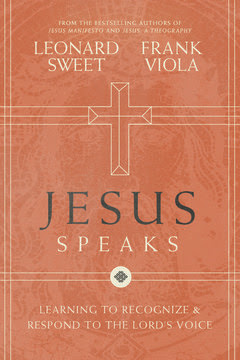
The chapters are all included in the Sampler for my new book with Leonard Sweet entitled, JESUS SPEAKS: Learning to Recognize & Respond to the Lord's Voice.

This new hardcover book (which also comes in Kindle and Nook) covers the waterfront on the subject of hearing the voice of Jesus. Everything from visions, dreams, spiritual instincts, the four characteristics that mark the voice of Jesus, how to prepare your heart to hear the Lord, the audible voice of God, hearing Jesus through the body of Christ, how to have your own "Jesus Calling" experience, the hindrances to hearing the Lord's voice, and the dangers associated with hearing His voice are all treated.

As far as I know, Jesus Speaks is the most practical book on how to recognize the voice of Jesus and respond to Him. It demystifies the whole process.

The Sampler also contains the Table of Contents so you can see exactly what the book covers.

JESUS SPEAKS officially releases in a few weeks, but you can pre-order it now on discount and be the first to receive it by going to http://JesusSpeaks.me

The Sampler is also on that page.

I look forward to hearing your feedback on the book.

My prayer is that it will help many. Especially those of you who have felt, "Why does the Lord seem to be speak so clearly to others but not to me?"

     Your brother,

     fv

     Psalm 115:1

Thursday, July 21, 2016

Is Pokemon Go Evil, Dangerous or Demonic?


As the Pokemon Go craze continues to sweep the nation, it is inevitable that this game will be hotly debated in Christian circles. ( REUTERS/Chris Helgren)

One week ago, a game called Pokemon Go was launched, and over the last seven days it has become an international phenomenon. It is the first mass market video game to successfully blend the real world and the digital world together in a way that the public truly embraces, and it is making headlines all over the planet. At this point it has almost as many daily active users as Twitter does, and Nintendo's stock price is going crazy as a result. On Monday it shot up 25 percent, and on Tuesday it surged another 13 percent. In other words, Nintendo is now worth billions of dollars more than it used to be. But is there a dark side to Pokemon Go? Is it potentially evil, dangerous or demonic?

Many people would dismiss such questions as complete nonsense. Unlike most video games, Pokemon Go actually requires people to leave their homes, get some exercise and visit real places. This type of game is being called "augmented reality," and it is bringing people together in new and interesting ways. In fact, the Washington Post is reporting that a lot of people are actually ending up in church as they hunt Pokemon creatures.

But not everything is unicorns and lollipops with this new game. Over the past week, we have seen people commit robberies at Pokemon Go locations, and there are very serious data security concerns. The following comes from Ricky Scaparo...

New reports are now coming in of the practical dangers of this game such as a recent report out of Baltimore where multiple people were robbed playing the "Pokemon Go" game last week, according to the Baltimore County Police Department. And then there is personal security concerns that have surfaced as a new report indicated that players that have logged into the game using their Google account may have given the app permission to go through all of their Google data, including emails and website history.

But much more alarming to many is the content of the game itself. As Mena Lee Grebin has pointed out, "Pokemon" actually comes from two Japanese words that mean "Pocket Monster"...

Meaning of the word Pokémon: a contraction of two Japanese words, "Poketto" and "Monsut," meaning "Pocket Monster"

Definition of Monster: a creature that is typically large, ugly, and frightening. Synonyms – rascal, beast, demon, brute, imp, devil.

Even the Washington Post admits that there are creatures such as "a flaming demon" in Pokemon Go. As players progress through the game, they collect these monsters and demons, train them, and have them fight against Pokemon owned by others. Here is more from Ricky Scaparo...

The Pokemon are supposed to be "monsters" that have special powers and share the world with humans. The idea of the game is to have the children learn how to collect as many Pokemon as possible, train them, and use them against other people's Pokemon by invoking the various abilities of each Pokemon creature. Pokemon can evolve and pass through various levels, 100 being the highest. Colored energy cards are sometimes used to aid the Pokemon.

But "it's just a game" right?

Maybe.

Maybe not.

Everything that we do, whether it is a "game" or not, trains us or conditions us in various ways. Often seeing something in a movie or coming across something in a video game can spark an interest or open a door into something deeper. For instance, occult organizations admit that one of their best recruiting tools is Harry Potter. After reading the books or watching the movies, many have found themselves curious about the occult world.

Realizing that, just consider some of the things that go on in the world of Pokemon. The following comes from the Christian Apologetics and Research Ministry...

Is Pokemon dangerous? Potentially, yes it is. It conditions the child who plays the game into accepting occult and evolutionary principles. Haunter can hypnotize, eat a person's dreams and drain their energy. Abra reads minds. Kadabra emits negative energy that harms others. Gastly induces sleep. Gengar laughs at peoples' fright. Nidoran uses poison. The psychic type of Pokemon are among the strongest in the game. Charmander, Haunter, Ivysaur, Kadabra and many more evolve. The children are taught to use these creatures to do their will by invoking colored energy cards, fights and commands. Much of it is reminiscent of occult and eastern mysticism.

But it goes even farther than that. According to occult expert Bill Schnoebelen, Pokemon players engage in all sorts of activities that would be considered deeply occult if they were done in real life...

Like many video games, Pokémon is riddled with occult concepts. Concepts like "magical stones," teleportation, ghosts, all-seeing eye, psychic power and using spirits to achieve results in the real world are all givens in this game realm. All of this is contrary to scripture. The Pokémon games and comics, etc., teach what I have called a magic worldview that is completely opposed to the Bible.

The Magic Worldview is the idea, common to all occult belief systems, that there is not really any sovereign Deity over creation. Instead, creation is ruled by a series of occult laws. In a sense, the universe is like a cosmic vending machine. As long as you put in the right coin (ritual or spell) you automatically achieve the desired result.

Particularly disturbing is the concept that children are being trained to "capture" demon-like creatures, train and control them, and use them against others. Many believe this very closely mirrors what many high-level occultists attempt to do with real demons. Here is more from Bill Schnoebelen...

The magician works from within a specially prepared magic circle which supposedly protects him from the demon as long as he stays inside it. He uses special magical weapons like a wand, staff or sword to threaten the demon and make it do his or her bidding. Once the ritual is successful, supposedly the demon belongs to the magician to do his or her bidding—as long as the stipulations of their contract are kept by sorcerer. Often the demon will grant the magician occult powers or give him or her special talismans to control others. This is a large part of high magic.

Now, there is barely a dime's worth of difference between this and what goes on in the "make-believe" Pokémon universe!

As the Pokemon Go craze continues to sweep the nation, it is inevitable that this game will be hotly debated in Christian circles.

And just like with the Harry Potter books and movies, many will become extremely upset at the suggestion that there might actually be something wrong with Pokemon Go.

But we all have a responsibility to evaluate what we are feeding into our minds, and this is especially true if you are a parent of young children.

In the end, everyone will do what they think is best for themselves, but as for me and my house we will definitely be staying far away from Pokemon Go.

Michael Snyder is the founder and publisher of End Of The American Dream. Michael’s controversial new book about Bible prophecy entitled "The Rapture Verdict" is available in paperback and for the Kindle on Amazon.com.

Thursday, June 2, 2016

Billy Graham reveals biggest spiritual mistake Christians make


While there is nothing wrong with doing good deeds, evangelist Billy Graham says this becomes a mistake when people base it as their only hope for getting to Heaven.

"The greatest mistake anyone can ever make is to assume that they are good enough to go to Heaven. And yet countless people make this mistake every day, thinking their good deeds will somehow outweigh their bad deeds and make them eligible for Heaven," he writes on his website.

The reason why this is a mistake is because God's standard is nothing short of perfection, explains Graham. God is absolutely holy and perfect, and just even one sin would be enough to banish people from His presence. In school, Graham says it's okay for students to make several mistakes just as long as they hit the passing mark, but the same cannot be said of God.

The Bible says of Him in Habakkuk 1:13: "Your eyes are too pure to look on evil; you cannot tolerate wrongdoing."

However, Graham says this does not mean that no one will ever get to Heaven. "The reason is because God has provided another way for us to be saved. That way is Jesus Christ. He was without sin (for He was God in human flesh)—but on the cross all our sins were placed on Him, and He took upon Himself the judgment and Hell that we deserve. He died in our place!" says the evangelist.

He is advising people to trust God and not in their own goodness for salvation. Graham says non-believers should now commit their lives to Jesus Christ as well as put their faith and trust in Him. "Then you will know that someday you will go to be with Him in Heaven forever—not because of your goodness, but because of His," he says.

Billy Graham warns the 'days of Noah are returning to the Earth'


http://www.christiantoday.com/reporter/czarina-ong

World-renowned evangelist Billy Graham warns that the "days of Noah are returning to the Earth," and should it finally happen, then it will be a "climactic event that will ring the curtain down on history."

"The Bible many times warns that toward the end of history as we know it, there will be a return to pre-flood conditions of gross sin and wickedness," Graham writes on his Decision Magazine. "The Scripture says concerning the people of Noah's day, 'Then the Lord saw that the wickedness of man was great in the earth, and that every intent of the thoughts of his heart was only evil continually' (Genesis 6:5)."

Graham adds that in the last days, there will be "perilous" things happening, what with men being "lovers of themselves, lovers of money, boasters, proud, blasphemers, disobedient to parents, unthankful, unholy, unloving, unforgiving, slanderers, without self-control, brutal, despisers of good, traitors, headstrong, haughty, lovers of pleasure rather than lovers of God, having a form of godliness but denying its power."

Even though the Bible did not say exactly when that judgment will come, "there are many indications that we are now living in the closing period of history."

People are called to repent and turn to Christ as the day of judgment draws near, says Graham. There are many who mistakenly assume they are already saved, but Graham warns they only have a "false notion" of what it's like to truly be a Christian since they continue living life any way they like.

"In their manner of living, they are indistinguishable from the world," he says. "It is true that they attend church with some regularity and do many good works, but they are not resting in the blood of Jesus Christ for their salvation, and they are not doing the works of faith that are required as an evidence of one's relationship with God."

Saturday, April 30, 2016

Hong Kong Mafia Boss Encounters Jesus Christ : Amazing Testimony