Showing posts with label Money. Show all posts

Sunday, April 28, 2019

The Myth of Generosity by Frank Viola

Image result for give money church offering

In the business world, entrepreneurs constantly teach people to be generous BECAUSE that’s the way to increase sales.

Mantras like “give, give, give, give, give, and once you’ve given 15 times, then ask and people will feel so blessed by your generosity that they will be generous toward you and buy your product or write a positive review about it.”

Not a few Christian teachers have passed this same idea on.

There is a problem, however.

Beyond the selfish motive that’s often involved (giving in order to get), the problem is that very few people – I’m speaking of Christians and Christian leaders – reciprocate when someone is generous to them.

Many (if not most) Christians and Christian leaders are takers. They have Ph.Ds in taking, but earn an F in giving back.

I won’t rehearse examples, for there are so many.

What’s even more disturbing about this is that generosity and reciprocation is better understood and practiced by non-Christians.

Recently, I was listening to a well-known secular podcaster (we’ll call him George) who interviewed another well-known personality (we’ll call him Tom) earlier this year on his show.

A month later, Tom reciprocated and had George on his show. This sort of mutual generosity is very common among non-believers.

You’d think it would be common among Christian leaders, who should be leading the way in generosity and reciprocation, but it’s not.

In fact, this kind of mutual blessing is exotically rare among Christian leaders today (I previously wrote about why here).

What’s my point?

The point is NOT to stop being generous.

The point is to learn how to LOSE and do it without becoming bitter.

That’s right.

LOSE. And LOSE again.

Those who have joined the Insurgence understand that when Jesus talked about “losing your life,” He wasn’t restricting that statement to physical death.

He was talking about living a lifestyle of losing, laying your life down, letting go, surrendering, and bearing the cross in daily life (= dying to self).

God will honor your generosity. But it will rarely come through the actions of those to whom you’ve been generous.

We have a generous God living in us. So be generous – especially toward those who are unable to reciprocate.

And always be armed with an attitude of losing.

Thursday, August 7, 2014

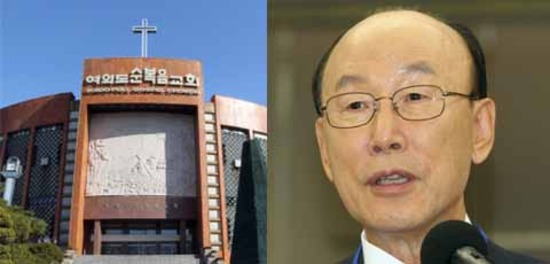
Yoido Full Gospel Church elders make explosive allegations of massive corruption


A supporter of Yoido Full Gospel Church senior pastor David Yonggi Cho reaches for the throat of former church elder Ha Sang-ok in a confrontation during a press conference by a group of 30 elders calling for Cho and his family to leave the church amid allegations of corruption, held at the Korea Ecumenical Building in Seoul’s Jongno district, Nov. 14. (by Kim Bong-gyu, staff photographer)
Senior pastor David Yonggi Cho accused of siphoning off millions in church funds; his camp denies the allegations

By Cho Yeon-hyun, religion correspondent


30 elders from Yoido Full Gospel Church, the world’s largest megachurch, held a press conference at the Korea Ecumenical Building in Seoul’s Jongno district on Nov. 14 to allege that senior pastor David Yonggi Cho and his family funneled off hundreds of billions of won from church donations.


The sheer scale of the amounts alleged by the elders to have been misappropriated is beyond the imagination. The elders made public a report from an investigation into three alleged improprieties by Cho made by a special investigation committee and ethics committee formed within the church last year. This time around, the allegations came from members of a group called the Prayer Meeting for Correcting the Church, including elders Kim Dae-jin and Kim Seok-kyun.

First, they claim that Cho returned only 64.3 billion won (US$60.2 million) of the 163.3 billion won (US$152.9 million) he borrowed from the church while building the CCMM Building between 1992 and 1998, when he was chairman of the church‘s Mission Society. The remaining 99 billion won (US$92.7 million), they say, was never returned.

By the elders’ account, construction payments of 28.5 billion won (US$26.7 million) and 16.6 billion won (US$15.5 million) were made at the time to Next Media Corporation and Facility Management Korea, companies managed by Cho’s eldest son Hee-jun.

It is also being claimed that Cho’s third son Seung-jae’s International Club Management Group bought three floors of the building from the church for 29.5 billion won (US$27.6 million) and sold them back three years later for 37.2 billion won (US$34.8 million) - pocketing the difference of 7.7 billion won (US$7.2 million).

In addition to allegedly appropriating 34.2 billion won (US$32 million) in Kukmin Ilbo newspaper lifetime reader memberships from 50,000 people for stock investments, Cho Hee-jun was also accused by the elders of making off with a total of 240 billion won (US$224.7 million) in assets related to the church.

They also claimed that David Cho’s wife Kim Sung-hae, president of Hansei University, has yet to account for 10.5 billion won (US$9.8 million) paid by the church as support for Bethesda Christian University, an institution she runs in the US. The elders also view US real estate purchased by the university for around US$15 million as having been bought with church money.

In total, the elders are accusing the Chos of embezzling as much as US$500 million or more in church money.

Associates of David Yonggi Cho insisted he had “no connection with any direct exchanges of money.”

Kim Sung-hae’s camp said the details of the Bethesda Christian University situation would be brought to light by prosecutors, who are currently investigating, but added that the elders’ claims were “merely allegations, not facts, and not worth responding to each one.”

The most explosive part of the allegations is the sheer amount of money supposedly received by David Yonggi Cho. The elders claim he received a severance payment of 20 billion won (US$18.7 million) when he stepped down as head pastor in 2008 - and that even that was decided without their knowledge or any voting by major church decision-making bodies. They also said no information was available on the whereabouts of 12 billion won (US$11.2 million) a year paid between 2004 and 2008 - 60 billion won in total - for “special missionary expenses.”

The elders gave a yearly total of 100 billion to 120 billion won (US$93.6-112.3 million) in donations received by the church. This would mean the annual amount taken in by the headquarters dropped by almost half from about 200 billion won a year when Cho spun off the Jisungjun center in downtown Seoul around the time he handed over senior pastor duties to Lee Young-hoon in 2008. Nevertheless, it remains the largest amount received in donations by any religious body in South Korea.

The elders also claim that Cho continued controlling the church even after his “retirement” by making decisions as “governor” - to the point where his successor Lee had difficulty exercising his authority on appointments and finances.

One of the former elders at the press conference, Ha Sang-ok, previously admitted to taking part in giving 1.5 billion won (US$1.4 million) while collecting the book “Madame Butterfly in Paris” from a female vocalist in France named Jeong who anonymously wrote the account about an affair with Cho.
“A sect leader might violate the commandments and do as he wishes, but a pastor cannot do that,” Ha said. “Over the past 14 years, I have met with Rev. Cho many times to try to persuade him to repent and return to being a great pastor, but the corruption has continued. That‘s why I had no choice but to disclose it to the outside world.”

The elders also made public a statement allegedly made by Cho saying he would give Jeong 1.5 billion won in exchange for her making no future mention of their extramarital relationship, along with copies of receipts for the two transactions totaling 3 billion won.
The church’s public relations office said the claims were “a personal matter that the church has no comment on.”

Lee Won-gun, an elder who functions as Cho’s “chief of staff,” said Cho is “unconcerned with money, to the point where I’ve never once seen him talk about giving money or not giving money to somebody.”

“There will be a response from this side after looking at the elders’ claims,” Lee added.
Cho is currently on trial for alleged causing 15.7 billion won (US$14.7 million) in damages to the church by instructing it to buy 250,000 shares of his eldest son’s stocks at a rate four times market value.

During the press conference, a physical altercation occurred when a number of Cho’s supporters attempted to rush the platform at the press conference and accused the elders of “insulting” the pastor.


Tuesday, May 27, 2014

John Piper Responds to Pastor David Yonggi Cho's Conviction for Embezzling $12M by Making Plea to US Pastors

Christian minister John Piper is seen in this photo shared publicly in 2012 by his Desiring God ministry on Facebook

When asked about the conviction of David Yonggi Cho, founder of world's largest Pentecostal congregation in South Korea, for embezzling $12 million from his church, popular pastor John Piper took the opportunity to warn pastors in the U.S. who might "love money," in a recent message.

"With every public dishonoring of Christ, every public dishonoring of His Word and His Gospel, and His Church, it makes me angry and it makes me sorrowful," said Piper in a recent episode of Ask Pastor John.

Yonggi Cho who pastors Yoido Full Gospel Church and oversees a network of churches numbering 800,000, was found guilty by a South Korean court for committing breach of trust and corruption amounting to $12 million, according to Yonhap News Agency. He received a suspended sentence of three years in prison with a five year probation and was ordered to pay a penalty of $4.7 million by Seoul Central District Court on Feb. 20.

One of Cho's sons, Hee-jun, who serves as secretary general of Yeongsan Christian Cultural Center and was a former chairman of Next Media, was sentenced to three years in prison.

"My response to this is really not to pile on any additional condemnation … but rather to try to respond for the rest of us in a way that tries to prevent these kinds of things," said Piper.

"I want pastors to keep watch on themselves. I have five pleas to pastors. My hope is that pastors will listen this and take this 68-year-old pastor's heart-aching that we not bring this kind of reproach on the name of Christ," he continued. He then listed five precautions pastors should take to avoid the sinful seduction of money.

1. Kill every desire to be rich and get rich

Don't want this. If you see the desire in your heart take aim at it with the words of Christ and the words of Paul and put it to death with a swift blow with the sword of the spirit. Jesus said how difficult it is for those who have wealth to enter the kingdom. In other words don't want this.

2. Pastors, if you see your income starting to grow, set a governor on it

Keep away from accumulating more and more and communicating to your people that you lay up treasures on earth. One of the best ways to do this I think, is to grow the percentage of your giving. I'm not impressed with a pastor who gives 30 percent of a million dollar royalty check and keeps 70 percent of it to buy luxuries with. I've heard pastors boast that they give 30, 40 percent. I'm not even impressed with giving 90 percent of a $10 million royalty check and keeping a million dollars to play with. While you look like every other millionaire and think that you have done a virtuous thing. Money is insidiously deceptive. We've seen it over and over again and I'm pleading with pastors, be content with what the church pays you and give the rest away with joy and strategic wisdom.

3. Be totally transparent with your fellow elders about your sources of income

These elders should not be the wealthy powerful peers from outside the church. That is an unbiblical way to lead your flock. It has no biblical foundation and it communicates distrust for your local leaders and a kind of pride that you are above their local accountability. Let all the books of your income be open to any member of your church who asks the elders. Secrecy around money is deadly. It's a sign that something is not right so work to give your ministry the flavor, 'we're not like peddlers of God's word.'

4. Live simply to show that your treasure is in heaven and not on earth

Please don't write this off as pauper theology. There goes Piper again with his pauper theology. That is absolutely ridiculous. The kind of distortion that makes of what I'm saying is a sign of fear that what I'm saying just might be true.

Get a car that works; that gets you where you need to go. Get a car that doesn't break down on you every few months. I'm talking about a modest entertainment budget that doesn't eat out every night. I'm talking about a refreshing vacation, not an exorbitant one. I'm talking about clothes that are unremarkable and undistracting, both for not being shabby and not being brand driven. I'm talking about a home that accomplishes your family and ministry purposes leaning towards ordinary folks in your congregation, not the wealthiest.

5. Put in place a leadership structure of a plurality of elders

A council of elders on which you the pastor have one vote. You are a chief among equals…not by having veto power over everyone else.

"I'm so jealous of these things because I am jealous for the name of Christ. His name is being blasphemed Paul said … the name of God is being blasphemed because of you. 'You abhor idols and you rob temples.' That is hypocrisy to the core … that is happening today because of pastors who love money," Piper ended.

http://www.christianpost.com/news/john-piper-responds-to-pastor-david-yonggi-chos-conviction-for-embezzling-12m-by-making-plea-to-us-pastors-115648/

David Yonggi Cho, Founder of World's Largest Church, Found Guilty of Breach of Trust, Corruption

By EDITORIAL DEPT. (NEWS@GOSPELHERALD.COM) Feb 24, 2014 08:57


David Yonggi Cho, founder of world's largest Pentecostal congregation, was found guilty by South Korean court for committing breach of trust and corruption of 13 billion won (US $12 million), according to Yonhap News Agency. 

Yoido Full Gospel Church senior pastor received a suspended sentence of three-year prison term with a five year probation and ordered to pay a penalty of 5 billion won (US $4.7 million) by Seoul Central Distrcit Court on Feb. 20, 2014. 

The court also sentenced Cho's elder son Hee-jun, secretary general of Yeongsan Christian Cultural Center and former chairman of Next Media, to a three-year prison term without suspension. He was formally arrested before the court ruling, the Yonhap News reported.

In 2002, while serving as chairman of a church-affiliated newspaper Kookmin Ilbo, Hee-jun sold the church 250,000 shares of stock in I-Service at 86,984 won (US$80.06) per share, which was much more expensive than the market price of 24,032 (US$22.12) per share, the hankyoreh reported.

Prosecutors identified David Cho as an accomplice to the crime of breach of trust, claiming that Cho used the money to help his son recover losses made in stock investements. 
  
According to hankyoreh, Cho had directed the transaction, which the church has "absolutely no need for" and resulted in a loss, to be dealt with as quietly as possible despite his full knowledge of the potential "uproar" from the elders and congregation if they find out.

The church's loss of 131 billion won resulted in 29 church elder's filing the lawsuit in 2011, accusing him of embezzling US $20 million. In addition, prosecutors acquired evidence of tax evasion during the investigation, where Cho was suspected of evading 3.5 billion won (US $3.2 million). 

While Cho has denied the allegation, he has also been criticized for privatizing church assets. 

Although the judge believes that Cho should be severely punished for committing breach of trust, especially for a person of his status in society, he gave a light sentence on Cho's tax evasion in consideration of Cho's long-term contributions to the society, the Yonghap News reported. 

The court sentenced Hee-jun to three years in prison for being the main culprit, who tried to evade responsibility - placing his personal financial loss on the church and the blame on others. 

Cho, 78, founded Yoido Full Gospel Church in 1958 and it now claims more than 450,000 followers. His proteges have built their own "disciple churches" across the country, creating a congregation of around 800,000, with Cho as the leader. 


David Yonggi Cho Responds to Guilty Verdict: 'Hardest Day of 50 Years of Ministry Service'

Pastor David Yonggi Cho, founder of the world's largest Pentecostal congregation, gave his reflection during the first Sunday Service after a South Korean court found him guilty of breach of trust, corruption and tax evasion, and sentenced him to three years in prison with a five-year probation and 5 billion won (US$4.67 million) in fines.

The 78-year-old disgraced megachurch pastor said that it was the hardest day of his 50 years of ministry when he heard the verdict on Thursday.

"Through this suffering, I've learned a homework. An individual shouldn't possess anything," Cho told his congregation at Yoido Full Gospel Church on Feb. 23, 2014. "Besides health, status, fame, authority, money... these are all matters that are outside the body and unworthy of any pursuit."

According to reports, Cho was identified as an accomplice through committing breach of trust in 2002 by ordering the church to purchase his elder son Hee-jun's stocks at four times the market price. The transaction resulted in the church's loss of 13 billion won (US$12 million). Moreover, Cho was also found guilty of tax evasion of 3.5 billion won (US$3.3 million).

In the same ruling, Cho's elder son Hee-jun, the former CEO of the church-affiliated local daily Kookmin Ilbo, was sentenced to three years in prison for colluding with his father in the embezzlement scheme.

Cho did not argue against the judgment, but, instead, examined himself from the perspective of faith.

"God forbid, if God calls me back today, I will still be able to go to the Kingdom of God," he said. Cho then asked that the congregation to pray for his successor pastor Young Hong Lee.

In his sermon, Lee apologized to the congregation for the negative impacts that Cho's case have brought upon them. He encouraged them to forget the past and press on towards the future, and to continue the spread of the Gospel to those who have yet to receive the great love of Christ.

Senior pastor Lee said that Yoido Full Gospel Church was purchased with a heavy price - the blood shed by Lord Jesus Christ. Therefore no power of darkness can divide the church. Lee encouraged the congregation to become one body in the Holy Spirit and to be more diligent in the Lord's Holy work.


Wednesday, May 21, 2014

6 Ways to Prevent an Embarrassing Ministry Scandal

pastor scandal

The recent sentencing of Dr. Yonggi Cho of South Korea is a reminder that we need a fresh commitment to integrity.

I was devastated to learn last week that South Korean megachurch pastor David Yonggi Cho was found guilty of embezzling $12 million in church funds. I was aware that the famous hero of faith was struggling with problems at his massive congregation, Yoido Full Gospel Church, which is in Seoul. Cho’s 56-year effort to build what is now the world’s largest church made him one of the most respected spiritual fathers in thePentecostal movement.

Some American leaders knew that Cho’s problems were linked to his son Cho Hee-jun, who was also convicted and sentenced to three years in prison for his role in an elaborate stock scheme that involved millions of dollars of church money. Hee-jun was immediately jailed. Thankfully, the elder Cho will not have to serve his prison sentence (it was suspended), but he will have to pay a $4.7 million fine.

I still respect Dr. Cho. A former Buddhist, he had a dramatic conversion to Jesus and was used by the Holy Spirit to bring the gospel to a nation that for centuries was closed to Christianity. Cho remains a legend. But the events of last week serve to remind us that even the greatest spiritual giants have feet of clay, and even the biggest ministries can fall into scandal if principles of integrity are not practiced.

This seems the best time to offer the simple reminders below. Today a new generation of megachurch pastors and ministry leaders has emerged, and this generation may not be aware that a few wrong moves could put them in the middle of the next big ministry scandal. If you are a leader, please post these rules in your board room, in your CEO’s office and in your ministry’s employee manual. If you are not in leadership, please pray that these rules are followed at your church, no matter how big it is:

1. Never build a cult of personality. The top reason ministries fail is that the organization starts revolving around a person instead of Christ. I don’t care how gifted or anointed the leader is—if he (or she) allows others to put him on a pedestal or if he climbs there himself, a fall is coming. Paul told the Corinthians, “For no man can lay a foundation other than the one which is laid, which is Jesus Christ” (1 Cor. 3:11, NASB). Paul didn’t build his ministry on himself. In addition, he shared the spotlight with his successor, Timothy, and his other team members. If a leader can’t share power, he is headed toward disaster.

2. Develop a culture of openness. Healthy ministries encourage staff members and church members to give input. I’ve found that in ministries that experienced scandal, employees constantly felt intimidated, controlled or even threatened. Did you know that the word occult comes from a Latin word that means “secret” or “covered up”? Ministries that engage in cover-up or secrecy are not managing their work in a Christian manner.

3. Insist on financial transparency. Churches and ministries are funded by donors, and donors have a God-given right to know that their funds are being used properly. Ministry leaders also have a God-given stewardship, and they must acknowledge that the funds given to them are not for personal gain. All financial transactions of a ministry should be scrutinized by designated leaders (including an outside accountant) to prevent corruption.

4. Don’t build a family dynasty. There is nothing in the Bible that says a Christian leader is supposed to turn his ministry over to his family. And nepotism is often the cause of financial scandal. If a leader stacks his board or church staff with family members, they will be tempted to make financial decisions that benefit themselves. And in many cases, parents who employ their children find it difficult to bring correction when there are serious offenses.

5. Beware of creating a greed monster. In today’s megachurches, huge amounts of money begin to roll in on Sundays—and if leaders are not careful, this kind of success can eventually destroy them. We must remember that God entrusts us with these funds in order to engage in the work of ministry, not to provide leaders with mansions, luxury vehicles, bodyguards, private jets, shopping allowances and second or third homes. When you feed greed, it will always come back to bite you. I personally believe that pastors and ministry leaders should voluntarily put a cap on their salaries instead of insisting on being treated like corporate bigshots.

6. Never tolerate a spirit of entitlement. Financial blessing can affect people in dramatically different ways. One person can humbly receive it, thank God for it and live in constant gratefulness and humility. The next person can accept the blessing and then begin to think they deserve royal treatment. This spirit of entitlement can invade a church or ministry subtly at first, until leaders begin to make demands. I once knew a preacher who asked to be driven from her hotel to the conference in a limousine—yet the distance was less than one block! This insane behavior should be confronted, not coddled.

Paul told his spiritual son Timothy that church leaders must be “free from the love of money” (1 Tim. 3:3) in order to assume that responsibility. We would do well to revisit that mandate today. Instead of tarnishing ourselves with another scandal, let’s show the world that we can handle money properly.

J. Lee Grady is the former editor of Charisma and the director of the Mordecai Project (themordecaiproject.org).


Friday, August 12, 2011

The Great Magician

by Peter Briscoe

The alchemists throughout world history have sought to create something out of nothing and more specifically gold out of base metal. Today modern financial alchemists endeavour to create wealth out of money – something which can never happen.

In God’s economy, wealth is represented by what He has created (people, land, natural resources, animals, plants) and by the work of man to add value to these expressions of wealth by honest work. Money, as such, has no intrinsic value. It represents a promise and only has value because of government regulation or law. This value is constantly diminishing due to inflation, printing more money and even governments purposely devaluing or even walking away from their obligations.

This has been happening ever since the gold standard was abandoned. This gold standard has been in use almost since trading began (using gold and silver as coinage and later as a guarantee for paper money) as a fixed, absolute standard of value and was finally abandoned in 1970.

The great German author Goethe wrote a classic drama called “Faust.” Part One opens with Mephisto entering into a bargain with God for the soul of Faust. Faust thirsts after knowledge and understanding. In parallel with the testing of Job, God gives Mephisto freedom to lead Faust astray but determines eventually to lead Faust towards the light.

In Part 2, Faust attends the Emperor’s court with his constant companion Mephisto. The empire is in financial ruin through the extravagance of the court, but Mephisto and Faust devise a cunning solution to these problems. The currency of the empire has been always been based on Gold, but there is insufficient Gold to cover all the Emperor’s extravagant spending. Mephisto comes up with an answer. The Emperor owns much land under which there must be a lot of undiscovered gold. A promissory note can be issued for the value of this gold. The court of the Emperor is showered with this new paper money. The foundation of the empire has been moved through Mephisto’s cunning from the solidity of metallic gold to insubstantial promises on paper.

Goethe illustrates the truth that everyone who tries to be superior in knowledge to the Creator runs the risk of losing his soul. We ought not to think we are smarter than God and can create wealth by issuing paper money!

Jesus unmasked a fallen power behind money which he called Mammon. This power tries to enter a Faustian pact with us today by tempting us to increase wealth by trying to multiply money without any real and tangible wealth (gold, silver) or honest work behind the process. This can begin by gambling which morphs easily into speculation. It is also happening with today’s money supply that economists call ‘fiat money’, which has grown into electronic money and this is pro-creating like Mephisto’s money to become a monster. We experienced the terror of this monster in the credit crisis of the past few years.

Jesus asked a penetrating question. “For what is a man profited, if he shall gain the whole world and lose his own soul? Or what shall a man give in exchange for his soul?” (Matt. 16:26) Learning to live and work in God’s economy means to work with Him to multiply true wealth – not money!

Everything you learned about economics is wrong!

by Peter Briscoe

Imagine the end of a day’s sales conference at a large insurance company. The invited keynote speaker gets up and delivers this bombshell: “Everything you’ve heard so far is not true.”

Tony Campolo, professor emeritus of sociology at Eastern University in Pennsylvania, opened his speech with this statement after some power speakers had instructed the audience on how to “set up” clients, push the right emotional buttons, and close the deal. Tony’s task was to “psych up” the audience for a last big motivational push. You can imagine the shock when he said, “Everything you’ve heard so far is not true!”

“People are not things to be manipulated with the right techniques,” he said, “not economic objects; they are entitled to love.” Love is the “killer app” in business he said.

In our economics class we learned that one of the fundamental principles in economics is the management of scarcity. Herein lies a distinctive difference with God’s economy. God knows no scarcity! He is the creator of an abundant earth with more than enough for all. The song goes, “he owns the cattle on a thousand hills, the gold in every mine!”

On a personal level, I read recently from David VanDrunen’s Living in God’s Two Kingdoms”.The explanation lies not in a complex theory worthy of a Nobel Prize economist, but in the mysterious, wonderful, economics-defying work of God. He “is able to make all grace abound to you, so that having all sufficiency in all things at all times, you may abound in every good work” (2 Cor. 9:8). When the impoverished give generously, God makes them “enriched” in the experience (9:11). In part, this is about money, but only in part.

He then goes on to define Kingdom Economics. “In the church there are no winners and losers, but every act of love is mutually enriching in Christ’s economics — an economics built not on the principle of scarcity but on the principle of extravagant abundance. As the church defies the constraints of the common kingdom’s justice so it also defies the constraints of its economics.

God’s abundance must never be an excuse for materialism. God’s plan is for prosperity with a purpose – to make and manage money to fulfil God’s purposes. He will prosper us so that we can bless others with our overflow!

Technical progress and innovation is making the old scarcity theory extremely shaky. Generosity , an expression of love, makes it totally redundant!

Wesley’s three rules for money management

John Wesley’s teaching on money offers simple, practical guidelines for every believer.

His first rule about money was Gain all you can. Despite its potential for misuse, money in itself is something good. There is no end to the good it can do: “In the hands of (God’s) children, it is food for the hungry, drink for the thirsty, raiment for the naked. It gives to the traveler and the stranger where to lay his head. By it we may supply the place of a husband to the widow, and of a father to the fatherless. We may be a defense for the oppressed, a means of health to the sick, of ease to them that are in pain. It may be as eyes to the blind, as feet to the lame: yea, a lifter up from the gates of death!”

Wesley added that in gaining all they can, Christians must be careful not to damage their own souls, minds, or bodies, or the souls, minds or bodies of anyone else. He thus prohibited gaining money through industries that pollute the environment or endanger workers.

Wesley’s second rule for the right use of money was Save all you can. He urged his hearers not to spend money merely to gratify the desires of the flesh, the desires of the eye, or the pride of life. He cried out against expensive food, fancy clothes, and elegant furniture: “Despise delicacy and variety and be content with what plain nature requires.”

Wesley had two reasons for telling Christians to buy only necessities. The obvious one was so they would not waste money. The second was so they would not increase their desires.

The old preacher wisely pointed out that when people spend money on things they do not really need, they begin to want more things they do not need. Instead of satisfying their desires, they only increase them.

Wesley’s third rule was Give all you can. One’s giving should begin with the tithe. He told the one who does not tithe, “Thou dost undoubtedly set thy heart upon thy gold” and warned, “It will ‘eat thy flesh as fire!’” But one’s giving should not end at the tithe. All of the Christian’s money belongs to God, not just the first tenth. Believers must use 100 percent of their income as God directs.

In an age when a single man could live comfortably on 30 pounds a year, his annual income reached 1,400.

He recorded in 1731 that he began to limit his expenses so that he would have more money to give to the poor. He records that one year his income was 30 pounds and his living expenses 28 pounds, so he had 2 pounds to give away. The next year his income doubled, but he still managed to live on 28 pounds, so he had 32 pounds to give to the poor. In the third year, his income jumped to 90 pounds. Instead of letting his expenses rise with his income, he kept them to 28 pounds and gave away 62 pounds. In the fourth year, he received 120 pounds. As before, his expenses were 28 pounds, so his giving rose to 92 pounds.

What a great example from this great man of faith! Read the full sermon

Your Work or Your Life? Don't repeat the mistakes of the past.

by Peter Briscoe - FCCI Director in Europe.  Peter is also the International VP of Crown Financial Ministries.

My first FCCI International Conference was in Cancun, Mexico in 2002.  Over the years these conferences have made a big impact on me, largely due to the practical application of faith in leading a business. At that time, I was just taking over as CEO of HE Space Operations, a company delivering specialized services to the European Space Agency at their main technical centre here in The Netherlands. As CEO of this hi-tech business, I was determined not to repeat some mistakes made during my very first assignment as CEO of a chemical company back in 1980.  My analysis of that period was simple. “ Success in business =  failure in life.”  Success in business came at a price that was not worth paying; my relationship with my wife and family,my health and my relationship with God all suffered.  The lessons I learned through FCCI helped me to understand the life/work balance much better.

  A survey conducted by the advertising and marketing firm Ogilvy & Mather showed that people would rather get out of the rat race than climb the corporate ladder. 76% said they would rather spend more time with family than make more money and 75% responded that they would trade job security over a job that offered an opportunity for a pay increase.

  Graceann Bennett, Managing Partner and Director of Strategic Planning at Ogilvy & Mather Chicago commented, “The most surprising thing about our study was how much consumers were saying what they would NOT do for money, even when money worries are high on the list. Prioritizing your life based on money is seen as a sure way to be disappointed since the pursuit of money is often reliant on factors outside of consumers’ control. They have gone down this road before and are saying that they are not necessarily happier or better off as a result.”

This reminds me of the words of Jesus when He warned, “What does it profit a man if he gains the whole world but loses his life?” Money always promises much but delivers little. You can buy a bed, but not rest; medicine but not health; a house but not a home. I know from my own experience that you can be a success in business but fail at life.  John D. Rockefeller said, “The poorest man I know is the man who has nothing but money." An old mentor of mine said many years ago that when you get to the end of your useful working life, you will never regret that you didn’t spend enough time at work. You will regretthat you spent too little time with your family!

Thanks to FCCI, I am much better equipped to manage my career and family choices in line with God’s greater plan.  I encourage you to come to the 2011 International Conference and discover what God has in store for you.

Saturday, January 1, 2011

The ‘Great Wealth Transfer’ — 100 Percent Returns!

by Holy Pivec

(Former managing editor of Biola University’s magazine, Biola Magazine, and a former contributing writer to the Christian Research Journal. She has a master’s degree in Christian apologetics from Biola. She also operate the site http://www.fulfilledprophecy.com/.)

How can you get rich and build God’s kingdom at the same time?


By following the modern “apostles” and “prophets” — at least that’s what they claim. They say a “great transfer of wealth” is about to occur — from the wicked to the righteous.

If you want to be on the receiving end of the transfer, then you’d better get “properly aligned” with
them. What that boils down to is submitting yourself to them.

More than 30 so-called apostolic leaders taught people how to take part in the wealth transfer at the Financial K.E.Y.S. conference held earlier this month in Denver, Colorado. Speakers included Bruce Cook, Lance Wallnau, Os Hillman, Cindy Jacobs, Rick Joyner and C. Peter Wagner. See the full list here. The name of the conference — Financial K.E.Y.S. — refers to their teaching that money is the key to global transformation and establishing God’s kingdom on earth. As Wagner says in his book Dominion!:

“If you check back through human history, you will find that three things, more than any others, have produced social transformation: violence, knowledge and wealth — and the greatest of these is wealth! (page 181)

To make the wealth transfer happen, Wagner claims that God is raising up a special group of apostles called workplace apostles. He says they will have the ability to make investments that will yield extraordinary returns:

“They will not be traditional financial planners who are satisfied with annual returns of 5 percent to 20 percent or so. … I have faith that we will see the biblical standard of 100 percent returns or more become the norm” (Dominion!, page 196).

Wagner and company claim that their prophecies about a “great transfer of wealth” have a biblical basis. Yet, the Scriptures they quote in support of this teaching are taken out of context. Let’s take a quick look at the two verses Wagner quotes in his book Dominion!.

Isaiah 60:11 and Proverbs 13:22

The first verse Wagner quotes is Isaiah 60:11:

“Therefore your gates shall be open continually; They shall not be shut day or night, That men may bring to you the wealth of the Gentiles, And their kings in procession.”

The chapter this verse is taken from, chapter 60, is about the restoration of the nation of Israel during the millennial reign of Christ. It’s not about the Church. The other verses in the chapter make this clear. Verse 14, for example, specifically names Israel’s capital city, Jerusalem, when it refers to “the city of the Lord” and “Zion” (these are two other names for Jerusalem).

In light of the rest of the chapter, it’s clear that verse 11 is saying that the wealth of the Gentile nations (non-Israelite nations) will be brought to Israel during the millennium, after Christ’s return to earth. It has nothing to do with wealth being transferred to the Church, today, through so-called workplace apostles.

The second verse Wagner quotes as support for a “great transfer of wealth” is Proverbs 13:22:

“But the wealth of the sinner is stored up for the righteous.”

Actually, Wagner only quotes part of verse 22. He completely leaves out the first half of the verse without telling his readers that’s what he’s done. But the full verse sheds more light on its meaning. Here it is: “A good man leaves an inheritance to his children’s children, But the wealth of the sinner is stored up for the righteous.”

So, this proverb is about inheritances and the lasting legacy left by the righteous versus the fleeting prosperity of the wicked. I don’t know how Wagner — someone with multiple theological degrees - could take a simple proverb about inheritances and legacies and turn it into a teaching about the end times, workplace apostles and a wealthy Church.

Apostles and Wealth

Many of today’s apostles insist that they must possess vast sums of money to defeat the forces of darkness and advance God’s kingdom. Yet, Peter and John — two of the original apostles — didn’t have much money and God used them mightily. They relied on something even more powerful than money — the authority of Christ.

Once, when a crippled beggar asked them for money, Peter replied:

“I do not possess silver and gold, but what I do have I give to you: In the name of Jesus Christ the Nazarene–walk!” (Acts 3:6)

Never once did the original apostles say wealth was a key to the Church’s success. Yet today’s apostles claim it is indispensable.

Friday, December 31, 2010

Money Money Money - Part 4 of 4

CHAPTER 4 - The Poverty of Christ
by Andrew Murray

You know the grace of our Lord Jesus Christ, that, though He was rich, yet for your sakes He became poor, that you through His poverty might become rich." 2 Cor. 8:9.

"Through his poverty": what does that mean? That He dispossessed Himself of all heavenly and earthly possessions that the riches of earth and heaven might be ours? That He so took our place, as in our stead to walk in the path of earthly poverty, that we in comfort and ease might enjoy the heavenly riches he has won for us? Or has that "through his poverty" a deeper meaning, and does it imply that His poverty is the very path or passage that He opened up through which all must go who would fully enter into His riches? Does it mean that, just as He needed in poverty of spirit and body to die to the world that He might open for us the way to the heavenly treasures, so we need to walk in His footsteps, and can only through His poverty working in us, through fellowship with His poverty, come to the perfect enjoyment of the riches He came to bring? In other words, is the poverty of Jesus something for Him alone, or something in which his disciples are to share?

There is scarce a trait in the life and character of Christ in which we do not look to Him as an example -- what are the lessons His Holy Poverty has to teach? Is the right to possess and enjoy the riches of earth as it is now everywhere practiced in the Church part of what Christ has secured for us? Or, is it possible that the lack of faith in the beauty and blessedness of the poor life of Christ Jesus is part of the cause of our spiritual poverty; our lack of Christ's poverty the cause of our lack of His riches? Is there not a needs-be that we not only think of the one side, �for your sakes he became poor"; but as much of the other, "For His sake I suffer the loss of all things?"

In seeking an answer to these questions, we must first turn and gaze upon our blessed Lord, if maybe the Holy Spirit will unfold somewhat of the glory of this His blessed attribute. Unless our heart be fixed upon our Lord in patient and prayerful contemplation, and we wait for the Holy Spirit to give us His illumination, we may indeed have our thoughts about this Divine poverty, but we cannot really behold its glory, or have its power and blessing enter our life. May God give us understanding!

Why Christ had to become poor. We must first of all see what the reason -- the needs-be -- was of this earthly poverty of Christ. He might have lived on earth possessed of riches, and dispensing them with wise and liberal hand. He might have come in the enjoyment of a moderate competency, just enough to keep Him from the dependence and homelessness which was His lot. In either case He might have taught His people of all ages such precious and much-needed lessons as to the right use of the things of this world. What a sermon His life would have been on the far-reaching words: �They that buy as though they possessed not.� But no, there was a Divine necessity that His life must be one of entire poverty. In seeking for the explanation, we shall find two classes of reasons. There are those which have reference to us and His work for us as our Savior. There are others which are more closely connected with His own personal life as man, and the work the Father wrought in Him, as He perfected Him through suffering.

Of the reasons referring to His work, the principal ones are easily named. Christ's poverty is part of His entire and deep humiliation, a proof of His perfect humility -- His willingness to descend to the very lowest depths of human misery, and to share to the full in all the consequences of sin. The poor have in all ages been despised, while the rich have been sought and honored: Christ came to be the despised and neglected of men in this, too.

Christ's poverty has ever been counted one of the proofs of His love.

Love delights in giving, perfect love in giving all. The poverty of Christ is one of the expressions of that self-sacrificing love which held back nothing, and seeks to win us for itself by the most absolute self-abnegation on our behalf. Christ's poverty is His fitness for sympathizing and helping us in all the trials that come to us from our relation to this world and its goods. The majority of mankind has to struggle with poverty. The majority of God's saints have been a poor and afflicted people. The poverty of Christ has been to tens of thousands the assurance that He could feel for them; that, even as with Him, earthly need was to be the occasion for heavenly help, the school for a life of faith, and the experience of God's faithfulness the path to heavenly riches.

Christ's poverty is the weapon and the proof of His complete victory over the world. As our Redeemer, He proved by His poverty that His kingdom is not of this world, that as little as He feared its threats or its death could He be tempted to seek help from its wealth or strength.

But these reasons are more external and official; the deeper spiritual significance of Christ's poverty will be disclosed as we regard it as part of His training as the Son of Man, and His exhibition of what the true life of man is to be.

Christ's poverty was part of that suffering through which He learned obedience and was perfected by God as our High Priest. To human nature poverty must ever be a trial. We were made to be kings and possessors of all things. To have nothing costs suffering.

Christ's human nature was not, as the Docetae taught, a mere appearance or show. There never was one so really, so intensely, a man as Christ Jesus: "true man of true man." Poverty implies dependence on others; it means contempt and shame; it often brings want and suffering; it always lacks the means and power of earth. Our blessed Lord felt all this as man. And it was part of that suffering through which the Father worked out His will in His Son, and the Son proved His submission to the Father, and His absolute trust in Him.

Christ's poverty was part of His school of faith, in which He Himself first learned, and then taught men, that life is more than meat, and that man lives "not by bread alone, but by every word that proceeds out of the mouth of God." In His own life He had to prove that God and the riches of heaven can more than satisfy a man who has nothing on earth; that trust in God for the earthly life is not vain; that one only needs as much as it pleases God to give. In His person we have witness to the power which comes with the preaching of the Kingdom of Heaven when the Preacher Himself is the evidence of its sufficiency.

Christ's poverty was one of the marks of His entire separation from the world, the proof that He was of another world and another spirit. As it was with the fruit good for food and pleasant to the eye, sin entered the world, so the great power of the world over men is in the cares and possessions and enjoyments of this life. Christ came to conquer the world and cast out its prince, to win the world back to God. He did so by refusing every temptation to accept its gifts or seek its aid. Of this protest against the worldly spirit, its self-pleasing and its trust in the visible, the poverty of Christ was one of the chief elements. He overcame the world first in the temptations by which its prince sought to ensnare Himself, then and through that in its power over us. The poverty of Christ was thus no mere accident or external circumstance. It was an essential element of His holy, perfect life; one great secret of this power to conquer and to save; His path to the Glory of God.

The Poverty of Christ's Disciples.

We want to know what our share in this poverty of Christ is to be, whether and how far we are to follow His example. Let us study what Christ taught His disciples. When he said to them, "Follow Me," "Come after Me, I will make you fishers of men," He called them to share with Him in His poor and homeless life, in His state of entire dependence upon the care of God and the kindness of men. He more than once used strong expressions about forsaking all, renouncing all, losing all. And that they understood His call so is manifest from their forsaking nets and customs, and saying, through Peter, "We have forsaken all and followed You." The call of Christ to come after Him is often applied as if it was the call to repentance and salvation. This is by no means the case. The principles the call involves have their universal application; but, to expound and enforce them in truth, it is of great consequence first to understand the meaning of the call in its original intention. Christ separated for Himself a band of men who were to live with Him in closest fellowship, in entire conformity to His life, under his immediate training. These three conditions were indispensable for their receiving the Holy Spirit, for being true witnesses to Him and the life which He had lived and would impart to men. With them, as with Him, the surrender of all property and the acceptance of a state of poverty was manifestly a condition and a means without which the full possession of the heavenly riches in such power as to convince men of their worth could not come.

With Paul the case appears to have been very little different. Without any express command we know of, the Spirit of his Master so possessed him, and made the eternal world so real and glorious to him, that its expulsive power made every thought of property or position disappear. He learnt to give utterance, as no one else ever could do, to what must have been our Blessed Lord's inmost life in the words he uses of himself: "as poor, yet making many rich; as having nothing, yet possessing all things." And in his wonderful life, as in his writings, he proves what weight it gives to the testimony concerning eternal things when the witness can appeal to his own experience of the infinite satisfaction which the unseen riches can give. In Paul, as in Christ, poverty was the natural consequence of an all-consuming passion, and made him a channel through whom the Invisible Power could flow full and free.

The poverty of Christ in His Church.

The history of the church tells us a sad story of the increase of wealth and worldly power, and the proportionate loss of the heavenly gift with which she had been entrusted, and which could alone bless the nations. The contrast to the Apostolic state is set in the clearest light by a story that is told of one of the Popes. When Thomas Aquinas first visited Rome, and expressed his amazement at all the wealth he saw, the Pope said, "We can no longer say, �Silver and gold have I none.�� �No, indeed;" was the answer, "nor can we say, �What I have, that give I you. In the name of Jesus Christ of Nazareth rise up and walk.�� The earthly poverty and the heavenly power had been closely allied, with the one the other had gone. Through successive ages the conviction ever came that it was only by a return to poverty that the bonds of earth beneath would be broken and the blessing from above brought back. And many a vain attempt was made to secure to poverty a place in the preaching and practice of the church such as it had been in Pentecostal days. At times, the earnest efforts of holy men met with temporary success, soon to give way again to the terrible power of the great enemy -- the world.

There were various reasons for this failure. One was that men understood not that in Christianity it is not an external act or state that can profit, but only the spirit that animates. The words of Christ were forgotten: "The Kingdom of God is within you;" and men expected from poverty what only the Spirit of Christ, revealing itself in poverty, could accomplish. Men sought to make a law of it, to bind under its rules and gather into its brotherhoods, souls that had no inner calling or capacity for such imitation of Christ. The church sought to invest poverty with the mantle of a peculiar holiness, and by its doctrine of Counsels of Perfection to offer a reward for this higher perfection. She taught that, while what was commanded in the Gospel was the duty of all, there were certain acts or modes of living which were left to the choice of the disciple. They were not of binding obligation; to follow these counsels was more than simple obedience, a work of supererogation which therefore had special merit. Out of this grew the doctrine of the power the church has to dispense this surplus merit of the saints to those who were lacking. And, in some cases, poverty became only a new source of self-righteousness, entering into covenant with wealth, and casting its dark and deadly shadow over those it promised to save.

At the time of the Reformation, poverty had become so desecrated as a part of the great system of evil it had to combat, that, in casting out those errors, it cast out a part of the truth with them. Since that time it is as if our Protestant theology has never ventured to enquire what the place and the meaning and the power is which Christ and the Apostle really gave poverty in their teaching and practice. And even in our days, when God is still raising up not a few witnesses to the blessedness of giving up all to trust in Him, and of possessing nothing that one may possess him the more fully, the church can hardly be said to have found the right expression for its faith in the spirit of Christ's poverty, as a power that is still to be counted as one of the gifts He bestows on some members of His church. It will be found that there is no small difficulty in trying to formulate the teaching of Scripture so as to meet the views of Evangelical believers.

The poverty of Christ in our days.

I have spoken above of the errors connected with the teaching of the Counsels of Perfection. And yet there was a measure of truth in that teaching, too. The error was to say that the highest conformity to Christ was not a matter of duty, but of option. Scripture says, "To him that knows to do good and does it not, to him it is sin."

Wherever God's will is known, it must be obeyed. The mistake would have been avoided if attention had been paid to the difference of knowledge or spiritual insight by which our apprehensions of duty are affected. There is a diversity of gift and capacity, of spiritual receptivity and growth, of calling and grace, which makes a difference, not in the obligation of each to seek the most complete inner conformity to Christ, but in the possibility of externally manifesting that conformity in such ways as were seen in Christ.

During the three years of His public career, Christ gave Himself and His whole time to direct work for God. He did not labor for His livelihood. He chose for Himself disciples who would follow Him in this, forsaking all for direct work in the service of the Kingdom. For admission to this inner circle of Christ�s chosen ones, Christ demanded what He did not from those who only came seeking salvation. They were to share with Him in the work and the glory of the new Kingdom; they must share with Him in the poverty that owns nothing for this world.

From what has been said above it is clear that no law can be laid down. It is not a question of law, but of liberty. But we must understand that word "liberty" aright. Too often Christian liberty is spoken of as our freedom from too great restraint in sacrificing our own will, or the enjoyment of the world. Its real meaning is the very opposite. True love asks to be as free as possible from self and the world to bring its all to God. Instead of the question, "How far am I, as a Christian, free still to do this or the other?" The truly free spirit asks, "How far am I free to follow Christ to the uttermost! Does the freedom with which Christ has made me free really give us the liberty, in a love, which longs for the closest possible likeness and union with Him -- still to forsake all and follow Him! Among the gifts and calling he still dispenses to His church will there not be some whom by His spirit He still draws in this particular, too, to bear and show forth His image? Do we not need as much as when He and His apostles were upon earth, men and women to give concrete and practical evidence that the man who literally gives up all of earthly possession because he sets his heart upon the treasure in heaven, can count upon God to provide for the things of earth?

Is not, amid the universal confession of worldliness in the church and the Christian life, just this the protest that is needed against the so subtle but mighty claim that the world makes upon us? In connection with every church and mission and work of philanthropy the question is asked, "How is it that in Christian countries hundreds of millions are spent on luxuries, with scarce single millions for God's work? Calculations are made as to what could be done if all Christians were only to be moderately liberal. I fear all such argument avails little.

Help must come from a different direction.

It was of the innermost circle that He had gathered around Himself that Christ asked a poverty as absolute as His own. It is in the innermost circle of God's children, among those who make the highest profession of insight into the riches of grace and their entire surrender to it, that we must find the witnesses that His Spirit can still inspire and strengthen to bear His poverty. He has done it, and is doing it. In many a missionary and Salvation Army officer, in many a humble unknown worker, His Spirit is working out this trait of His blessed likeness. In the days we are looking for of deeper revival among God's children He will do it still more abundantly.

Blessed are all they who wait for him, to receive His teaching, to know His mind, and show forth His holy likeness. It is as the first, the inner, circle proves the power of His presence, that the second and the third will feel the influence. Men of moderate means, who may feel no calling to the poor life, will come under the constraining power of the example and feel compelled to sacrifice far more of comfort and enjoyment in Christ's service than they ever did before. And the rich will have their attention attracted to the danger signals God has set along their path. (Luke 18:25, Matt. 6:19, 21, 1 Tim. 6: 9, 10, 16). And will, by these examples, if they may not themselves share in Christ's poverty, at least be helped to set their hearts more intensely upon the treasure in heaven -- the being rich in faith, rich in good works, rich toward God -- and themselves heirs of God, heirs of the riches of grace, and the riches of glory.

Christ's poverty and the riches it brings.

�That you through His poverty might become rich." His POVERTY not only as an object of our faith, but as a matter of experience and fellowship is the passage through which the fullest entrance is gained into his riches. Let us present together some of the aspects we have already pointed out of the blessedness Christ's poverty and its voluntary fellowship brings.

What an aid to the spiritual life. It helps to throw the soul on God and the unseen; to realize the absoluteness of His presence and care in the least things of daily life; and is to make trust in God the actual moving spring of every temporal as well as spiritual interest. And because it is not possible to claim God's interposition for every day's food, if a man is not consciously walking in tender and full obedience, it links the soul to God's will and way by the closest of ties. The hourly needs of the body, which are so often our greatest hindrance, become wonderful helps in lifting our entire life into communion with God, and in bringing God down into everything. It elevates the spirit above the temporal, and teaches us in every state always to be content, always to rejoice and to praise.

What a protest against the spirit of this world. There is nothing the Christian life suffers more from than the subtle and indescribable worldliness that comes from the cares or the possessions of this life. Through it the God of this world exercises his hidden but terrible power. This is the Delilah in whose lap the God-separated Nazarite becomes impotent and sleeps. To awaken and shake out of this sleep more than preaching is needed, more than the ordinary Christian liberality, which quite comports with the full enjoyment of all that abundance can supply: there is needed the demonstration of the Spirit and of power that God enables men, and makes it to them an indescribable blessedness, like their Lord, to give up everything of the earth that they may more fully possess, and prove, and proclaim the sufficiency of the heavenly riches and the satisfaction they give. The protest against the spirit of this world will become the mightiest proclamation of the kingdom of heaven, the self-evidencing revelation of how heaven can even now take possession.

What entrance it will give into the image and likeness of Jesus. We adore our Lord in the form of a servant, and worship Him in it as the most perfect possible manifestation of a Godlike Humility and Love. His poverty was an integral and essential part of that form of a servant in which He dwelt. In all ages the love of some has given them no rest in the desire to attain the closest possible conformity to the blessed Lord. In Him the outer and inner were in such living harmony that the connection was not accidental; the one was the only perfect and fit expression of the other. In the body of Christ there are great diversities of gifts; the whole body is not eye, or ear, or tongue. So there are some who have the calling and gift to manifest this trait of His image, and for the sake of their brethren and the world, keep alive the memory of this too much neglected part of the ever blessed Incarnation. Blessed they Whom his Holy Spirit makes the representatives of this His wondrous grace that, though He was rich, He became poor.

What a power then this poverty of Christ becomes to make others rich. It is through His poverty we become rich. His poverty in His people brings the same blessing. In the church, many who do not feel the calling, or who in God's providence are not allowed to follow their desire for it, will be stirred and strengthened by the sight. When some witness testifies to the blessedness of entire conformity, others who are not called to this path will feel urged, in the midst of the property they possess and retain, to seek for as near an approach in spirit as is allowed them. Christian giving will not only be more liberal in amount, but more liberal in spirit, in the readiness and cheerfulness in the forethought and the actual self-sacrifice by which it will be animated.

Through their poverty, too, through Christ's poverty in them, many shall be made rich. Just as a specialist devotes himself to some limited branch of (say) medical science, and all profit by the exclusiveness of his researches, so through these, too, who love and live in and make manifest the poverty of our Lord, the church becomes all the richer. Through them the poverty of Christ gets a place in many hearts where it was not known, and it is seen how this was part of His overcoming the world, and how it may be a part of our victory that overcometh the world, even our faith.

Christ's poverty and our duty.

I have said that all have not the same calling. How are we to know what our calling is? We may so easily allow ignorance or prejudice, self-indulgence or worldliness, human wisdom or unbelief to sway us, to keep us from the simplicity of the perfect heart, and to blind us to the full light of God's perfect will. Let us see where the position is in which perfect safety will be found, and where we may confidently count upon the Divine guidance and approval.

A fortnight ago I stood by the bedside of a dying servant of God, Rev. Geo. Ferguson, the principal of our Mission Institute. He told me how he had been meditating on a text that had come in the course of his preparation for his Mission class: "Though your sins be as scarlet, they will be as white as snow." As he thought, it was as if one said to him, "White as snow, do you know what that is?" His answer was, "No, Lord, You only know, I do not." And then the question came, "White as snow, can you attain that? -- can you make yourself that?" "No, Lord, I cannot; but You can." And, again, he was asked, "Are you willing that I should do it?" �Yes, Lord, by Your grace I am willing. You should do all You can."

The three questions just suggest what our duty is. The heavenly poverty of Jesus Christ -- do you know what it is? What it is in Him, in his disciples and in Paul, in His saints in later days? What it would be in you? Let the answer be, "No, Lord, You know." This is what we need first and most of all. If God were to open our eyes to see the spiritual glory of our Lord in His poverty, in His entire renunciation of everything of worldly comfort or self-pleasing; if we saw the Divine glory of which it is the expression; if we knew how infinitely beautiful it was to all the holy angels, how infinitely well-pleasing to the Father, we should then only in some little degree be able to say whether it was something we ought to desire and imitate. If we saw the heavenliness and the measure of the likeness to our Lord it would bring into our life, we should say, "I have spoken of what I knew not -- Oh, that God would show me His glory in this too: �for your sakes He became poor, that you through His poverty might be rich�!" Before you judge of it, pray by the Holy Spirit to know it.

Then comes the second question. "Can you attain it? Can you, in the likeness of Jesus, give up everything in the world for God and your fellow men, and find your joy in the heavenly riches and the blessedness of dependence upon God alone?" "No, Lord, I cannot; but You can work." Come and gaze upon the Son of God and worship as you think. It was God that made Him what He was, and that God can, by His mighty power, work in me His Divine likeness. Ask God to reveal by His Spirit, what the poverty of Jesus is, and then to work in you as much of it as you can bear. Be sure of this, the deeper your entrance into His poverty, the richer you are.

And if the last question comes to search the heart -- "Are you willing for it?" -- then, surely, your answer will be ready: "By Your grace, I am!" You may see no way out of all the complications of your life. You may dread bringing upon yourself sacrifices and trials you could not bear. Be not afraid: you surely cannot fear giving yourself up to God's perfect love to work out His perfect will. For all He really means you to do He will most surely give light and strength. The Throne of Riches and Honor and Glory to which the Lamb has been exalted is surely proof enough that there is no surer way for us to riches and honor than through His poverty. The soul that in simplicity yields to the leading of her Lord will find that the fellowship of His suffering brings even here the fellowship of His glory:

"Though he was rich, yet for your sakes he became poor, that you through his poverty might be rich."

Related:
Money Money Money Part 1 of 4 - Must Read!
Money Money Money Part 2 of 4
Money Money Money - Part 3 of 4

Money Money Money - Part 3 of 4

CHAPTER 3 - The Grace of God and Money
by Andrew Murray

For you know the grace of our Lord Jesus Christ, that though he was rich, yet for your sakes he became poor, so that you through his poverty might become rich.� 2 Cor. 8: 9.

In this and the following chapters we have Paul's teaching on the subject of Christian giving. In connection with a collection he wishes the Corinthian Christians from among the Gentiles to make for their Jewish brethren, he opens up the heavenly worth of our earthly gifts, and unfolds principles which ought to animate us as we offer our money in God's service. He does this especially as he cites the example of the Macedonian Christians and their abounding liberality, and makes them for all time the witnesses to what God's grace can do in making the ingathering of money the occasion of the deepest joy, of the revelation of the true Christlikeness, and of abounding thanksgiving and glory to God. Let us gather up some of the principal lessons; they may help us to find the way by which our money can increasingly become a means and a proof of the progress of the heavenly life within us.

1. The Grace of God always teaches us to give. "We make known to you the grace of God which has been given to the churches of Macedonia." 2 Cor. 8:1. In the course of the two chapters the word grace occurs eight times. Once of "the grace of our Lord Jesus Christ, who for our sakes became poor." Once of "the grace which God is able to make abound to us." The other six times of the special grace of giving.

We all think we know what the word means. It is not only used of the gracious disposition in God's heart towards us, but much more of that gracious disposition which God bestows and works in us. Grace is the force, the power, the energy of the Christian life, as it is wrought in us by the Holy Spirit. We all know the command to stand fast in grace, to grow in grace, to seek for more grace. We rejoice in the words, exceeding grace, grace abounding exceedingly, grace exceedingly abundant. We pray continually that God would increase and magnify His grace in us.

We know the law of the Christian life: that no grace can be truly known or increased, except by acting it out. Let us learn here that the use of our money for others is one of the ways in which grace can be expressed and strengthened. The reason is clear. Grace in God is His compassion on the unworthy. His grace is wondrously free. It is always giving, without regard to merit. God finds his life and his delight in giving.

And when His grace enters the heart, it cannot change its nature: whether in God or man, grace loves and rejoices to give. And grace teaches a man to look upon this as the chief value of his money -- the Godlike power of doing good, even at the cost of enriching others by impoverishing ourselves.

Let us learn the lessons. If we have God's grace in us it will show itself in giving. If we want new grace, we must exercise what we have in giving. And in all we give we ought to do it in the consciousness of the grace of God that works it in us.

2. The Grace of God teaches to give liberally. "Their deep poverty abounded unto the riches of their liberality, for according to their power, yea, beyond their power, they gave of their own accord, beseeching us with much entreaty in regard of this grace." 2 Cor. 8:2. What a sight! And what a proof of the power of grace! These newly converted Gentiles in Macedonia hear of the need of their Jewish brethren in Jerusalem -- men unknown and despised -- and at once are ready to share with them what they have.

Of their own accord, they so give beyond their power, that Paul refuses to accept their gifts: with much entreaty they implore and persuade him to accept the gift. "Their deep poverty abounded unto the riches of their liberality."

It is remarkable how much more liberality there is among the poor than the rich. It is as if they do not hold so fast what they have: they more easily part with all; the deceitfulness of riches has not hardened them; they have learned to trust God for tomorrow. Their liberality is not indeed what men count such; their gifts are but small. Men say it does not cost them much to give all; they are so accustomed to have little. And yet the very fact of their giving it more easily is what makes it precious to God; it shows the childlike disposition that has not yet learnt to accumulate and to hold fast. God's way in His kingdom of grace on earth is ever from below, upwards. "Not many wise and not many noble are called. God has chosen the weak and the base things." And even so He has chosen the poor in this world, as they give out of their deep poverty, to teach the rich what liberality is.

"Far beyond their power gave they of their own accord, beseeching us with much entreaty that we would receive the gift." If this spirit were to pervade our churches and men of moderate means and of large possessions were to combine with the poor in their standard of giving, and the Macedonian example became the law of Christian liberality, what means would not flow in for the service of the kingdom.

3. The Grace of God teaches to give joyfully.

"The abundance of their joy abounded unto the riches of their liberality." (8:2.) In the Christian life joy is the index of health and whole-heartedness. It is not an experience for times and seasons: it is the abiding proof of the presence and enjoyment of the Savior's love. No less than our spiritual exercises, it is meant to pervade our daily duties and our times of trial: "a joy that no man takes from you." And so it inspires our giving, making the offering of our money a sacrifice of joy and thanksgiving. And as we give joyfully, it becomes itself a new fountain of joy to us, as a participation in the joy of Him who said "It is more blessed to give than to receive."

The blessedness of giving: would that men believed how sure this way to unceasing joy is, to be ever giving as God lives to give. Of the day when Israel brought its gifts for the temple, it is said "then the people rejoiced, because with a perfect heart they offered willingly to the Lord; and David the King also rejoiced with great joy."

That is a joy we may carry with us through life and through each day, unceasingly dispensing our gifts of money, our lives or service all around. God has implanted the instinct of happiness deep in every creature; it cannot help being drawn to what gives happiness. Let us get our hearts filled with the faith of the joy of giving: that joy will make to rich and poor our calls to give among our most precious privileges; it will be true of us, "and the abundance of their joy abounded to the riches of their liberality."

4. The Grace of God makes our giving part of our surrender to our Lord.

Paul says of their giving (8: 5), they not only did this, "but first they gave their own selves to the Lord." In this sentence we have one of the most beautiful expressions for what is needed to salvation, and what it is in which full salvation consists. A man who has given himself to the Lord: that comprises all our Lord asks of us; all the rest He will do. The expression is nowhere else found in Scripture; we owe it to this dealing with the matter of the collection. It tells us that giving money will have no value, except we first give ourselves; that all our giving must just be the renewal and carrying out of the first great act of self-surrender; that each new gift of money may be a renewal of the blessedness of entire consecration.

It is only this thought that can lift our giving out of the ordinary level of Christian duty, and make it truly the manifestation and the strengthening of the grace of God in us. We are not under the law, but under grace. And yet so much of our giving, whether in the church plate, or on the subscription list, or on special occasions, is done as a matter of course, without aught of the direct relation to our Lord. A truly consecrated life is a life moment by moment in his love; it is this that will bring us to what appears so difficult, ever to give in the right spirit and as an act of worship. It is this will make "the abundance of our joy abound to the riches of our liberality."

5. The Grace of God makes our giving part of the Christlike life.

"See that you abound in this grace also, for you know the grace of our Lord Jesus Christ, that though He was rich, yet for our sakes He became poor." (8:9.) Every branch and leaf and blossom of the mightiest oak derives its life from the same strong root that bears the stem. The life in the tiniest bud is the same as in the strongest branch. We are branches in Christ the Living Vine; the very life that lived and worked in Him. Of what consequence that we should know well what His life is, that we may intelligently and willingly yield to it. Here we have one of its deepest roots laid open; "Though he was rich, yet for your sakes he become poor, that you through His poverty might become rich." To enrich and bless us, He impoverished Himself. That was why the widow's mite pleased Him so; her gift was of the same measure as His: "She cast in all she had." This is the life and grace that seeks to work in us; there is no other mold in which the Christ-life can be cast. "See that you abound in this grace also; for you know the grace of our Lord Jesus, that he became poor." How little did the Macedonian Christians know that they were, in their deep poverty, and in the riches of their liberality, giving beyond their power, just acting out what the Spirit and grace of Jesus was working in them. How little we would have expected that the simple gift of these poor people would become the text of such high and holy and heart-searching teaching. How much we need to pray that the Holy Spirit may so master our purses and our possessions, that the grace of our giving will, in some truly recognizable degree, be the reflection of our Lord's. And how we need to bring our giving to the cross, and to seek Christ's death to the world and its possessions as the power for ours. So will we make others rich through our poverty, and our life be somewhat like St. Paul's: "poor, yet making many rich."

6. The grace of God works in us not only the willing, but the doing. (8:10.) "You were the first to make a beginning a year ago, not only to do, but also to will. But now complete the doing also; that as there was the readiness to will, so there may be the performance also." We all know what a gulf in the Christian life there often is between the willing and the doing. This prevails in the matter of giving, too. How many long for a time when they may be better off and able to give more. And meantime that wish, the fancied willingness to give more, deceives them, and is made to do duty for present liberality. How many who have the means, and intend doing something liberal, yet hesitate, and the large donation during life, or the legacy in the will, is never carried out. How many count themselves really liberal, because of what they will, while what they do, even up to their present means, is not what God would love to see. The message comes to all: "Now complete the doing also; that as the readiness to will, so the completion also, out of your ability."

"It is God who works in as to will and to do"; let us beware, in any sphere, of hindering Him by unbelief or disobedience, and resting in the �to will�, without going on to the �to do�. The Christian life needs exercise; it is by practice that godliness grows. If in anything we find that our giving has not been up to this Scripture model, not as liberal and joyful, not in as perfect accord with the spirit of our entire surrender to our Lord, or of His making himself poor for us, let us at once, in addition to the readiness to will, complete the doing also.

7. The grace of God makes the gift acceptable according to what a man has. (8:12.) "For if the readiness is there, the gift is acceptable according to what one has, not according to what he does not have." The God who sees the heart, judges each gift by the ability to give. And His blessed Spirit gives the upright heart the blessed consciousness that the gift on earth has found approval and acceptance in heaven. God has been careful in His Word to teach us this in every possible way. All the world's judgments of the value of gifts are reversed in heaven; the love that gives liberally according to what it has is met by the Father's love from above. Let us seek to redeem our giving from all that is commonplace and little by taking hold of the blessed assurance: it is acceptable. Let us refuse to give what appears to satisfy us: let us pause, and rejoice in God's call to give, and in His Spirit that teaches how much and how to give, and the deepest joy of giving will come to us -- the Spirit's seal that the Father is well pleased.

8. The grace of God through the giving works out the true unity and equality of all saints. (8:13.) "I say not this, that others may be eased and you distressed; but by equality, your abundance being a supply at this present time for their want, that their abundance may also become a supply to your want. That there may be equality. As it is written: He that gathered much, had nothing over: and he that gathered little had no lack." Another ray of heavenly light on this appeal for a collection. Money will become the bond of union that binds the Christians of Jerusalem and of Corinth into one. They are one as much as Israel was one people. As in their ingathering of the manna the feeble and the strong were to bring all into one store, that all might share alike, so in the body of Christ. God allows of riches and poverty, God bestows His gifts with apparently unequal hand, that our love may have the high privilege of restoring the equality. The want of some calls us to the love and the help and the blessedness of giving to others. And at another time, or in different spheres, the very ones who needed help may, in their turn, out of their abundance bless their helpers. Everything has been so ordered that love will have room to work, and that there will be opportunity to cultivate and to prove the Christlike spirit.

What a call and what a field in the needs of the world for all God's people to prove that God's plan is theirs: "that there may be equality," and that the spirit of selfish contentment with my greater privilege has been banished by the Cross. In philanthropy and missions what a need for all saints doing their utmost " according to their power -- yea, and beyond their power."

In sight of the heathen world, oh! what an appeal that there be equality and that we shall share and share alike with them what God gives us. What new, unthought of, eternal value, money gets as one of the powers for giving to the perishing, of the abundance we have in Christ.

There is no room left to enlarge on the further lessons of 2 Cor. 9. Let me just mention them:

(9: 6.) Let the giving be bountiful: it will bring a bountiful reward.
(9: 7.) Let the giving not be grudging or of necessity: the cheerful giver receives God's love.
(9: 8.) Let the giving be trustful: God will make all grace abound.
(9:11-13.) Your giving brings glory to God by the thanksgiving of those you bless.
(9:15.) Your giving reminds of God's giving, and calls to thanks for His unspeakable gift.

What a world of holy thought and heavenly light opened up by the gifts of the Macedonian and Corinthian converts! Will we not, under the power of that thought and light, review all our giving and see that it be brought into perfect accord with the Divine pattern in these chapters. Shall we not begin at once, and yield to Him, who became poor for us, everything that self-interest and self-indulgence has hitherto claimed and held. And shall we not beseech Him to show in us by His Spirit that the one worth and blessedness of money is to spend it for our Lord, to bless our fellowmen, to use it as an instrument and an exercise of grace, and so to turn even it into the treasure that lasts for eternity.

Related:
Money Money Money Part 1 of 4 - Must Read!
Money Money Money Part 2 of 4
Money Money Money - Part 4 of 4