Friday, June 27, 2014

The Chief Danger of the 21st Century by BERT M. FARIAS

Danger sign
Beware of a false gospel. (dlritter/rgbstock.com)

When backsliders, hypocrites and the halfhearted seeker among us are made to feel comfortable instead of convicted, soothed instead of smitten, pampered instead of pricked, then something is terribly wrong.


The holy fire of God is to burn so brightly in the church that it allows no room for indifference so that hypocrites will not be able to stay and the true seekers will not be able to remain unchanged.

“I marvel that you are turning away so soon from Him who called you in the grace of Christ, to a different gospel, which is not another; but there are some who trouble you and want to pervert the gospel of Christ. But even if we, or an angel from heaven, preach any other gospel to you than what we have preached to you, let him be accursed. As we have said before, so now I say again, if anyone preaches any other gospel to you than what you have received, let him be accursed” (Gal 1:6-9).

These are the strongest of words penned by the apostle Paul through the inspiration of the Holy Spirit to the Galatian Christians. Twice Paul declares a terrible curse on those who pervert the real gospel of Christ.

One of the great tragedies of the modern Western gospel has been the accentuation of the blessings and benefits of salvation to the exclusion of other components of the cross. There is a very large movement that is sweeping through many churches today that major on life-enhancement, self-help and self-esteem without hardly ever confronting sin and the works of the flesh. Sadly lacking from this sugar-coated gospel are heart repentance, holiness and the empowering grace of God to live in obedience to His demands.

The preachers of this smooth, soft gospel may frequently speak of forgiveness, but rarely do we hear a clear and definitive call for surrender in true repentance. They may even speak of the blood of Christ to cleanse us from our sins, but rarely do we hear of the necessity of that same holy blood to appease the wrath of God against sinners.

Frequently we may hear of how Jesus died to make us righteous, but rarely do we use God’s holy Law to strip the sinner of his self-righteousness. We may often hear of the need to gain the glories of heaven, but rarely of the need to shun the horrors of hell.

At times we may hear of the resurrection of His power (although in many circles that is rare, too), but rarely do we hear of the fellowship of His sufferings. Frequently we hear of the good life we can have now, but rarely do we hear warnings of the judgment to come. And why don’t we hear more of the latter? Because we don’t want to offend anyone.

The offense of the cross has been virtually removed from our gospel.

What Salvation Army founder William Booth prophesied more than a century ago is increasing at an alarming rate in our day:

“The chief danger of the 20th century will be:

Religion without the Holy Ghost

Christianity without Christ

Forgiveness without repentance

Salvation without regeneration

Heaven without hell

And politics without God.”

The 20th century has already passed, and things don’t seem to be improving at all in the 21st century.

A new gospel has been produced from the ruling philosophy of the day that says, “If it works, it must be better. If our message adds to our number, if it comforts the people instead of offending them, if it makes them happy, if it keeps them coming to our meetings and keeps them giving to our causes, then it must be good.” The results are what count.

This dominating school of thought regards anyone successful as long as they get the job done and accomplish the goals—in this case, growing the church and adding to its membership.

The proponents of this other gospel reason, “More people and more money equal success.” It doesn’t really matter how they accomplish their goals, as long as they do. In this philosophy God becomes a means to an end, a useful God to help them attain the desired success.

Others, to sound even more persuasive, may say, “More people means more salvations,” but are they really getting saved? Or “More money means a greater propagation of the gospel,” but is it the real gospel?

The constant popular emphasis on making the gospel relevant to our culture is both obnoxious and misguided because it’s based in the error that modern people must be reached on the humanist level of their self-interest—that they are otherwise incapable of patiently hearing the gospel before becoming offended by its demands for righteousness and holiness. The church must clearly defeat that error by showing that the real gospel is “the power of God unto salvation” for all people, for all time.

If we do not restore the true preaching of the gospel to this generation, the next generation will battle moral anarchy and societal decay never witnessed before in our land. It is happening now! Without strong gospel preaching, the church is destined to only be a phantom of what it was in its earliest beginnings, lacking the true power, endurance and character to influence the world for God.

Bert M. Farias, founder of Holy Fire Ministries, is the author of The Real Gospel and co-host of the New England Holy Ghost Forum. He is a missionary evangelist carrying a spirit of revival to the church and the nations. Follow him at Bert Farias on Facebook or @Bertfarias1 on Twitter.

Where's the Balance Between God's Love and God's Holiness? by BERT M. FARIAS

Love and justice
How do believers balance love and holiness? (CreationSwap/James Donaldson [edited])

Years ago I was preaching a series of strong holiness messages in a particular church. After one of the meetings the pastor said something to me that I've never forgotten. "The Lord has dealt with me about preaching more on love than holiness," he said.


That statement didn't sit well with me. I knew it was not accurate. Yet back then I didn't know why.  I pondered that pastor's statement with my own thoughts that raced through my head. Is love more important than holiness? Are they different, or are they virtually the same? They have to be different, or we'd have a lot of redundancy in the Bible, I thought. But how are they different? Although I knew the pastor's statement came from a lack of understanding true holiness, at that time I couldn't thoroughly explain the difference.

This pastor's statement put an emphasis on love, which is of primary importance, while de-emphasizing holiness, which is not only God's greatest attribute, but foundational to understanding man's relationship to God. I walked away from that conversation knowing that this pastor's view of holiness was not becoming or beautiful. I thought of how his view was probably shared by a multitude of believers, who have formed erroneous ideas and notions of holiness, due probably to their own negative experiences—like the cat who is afraid of water because of one negative experience of getting scalded by boiling water. Or of those who may have come from a background of legalism where do's and don'ts were associated with holiness. These are among the reasons holiness has gotten a bad rap and is looked upon with a sort of disdain, as being primitive, outdated and just not culturally relevant. We need to realize, however, that negative experiences or unsound teaching does not nullify the real meaning, necessity and beauty of God's holiness.

What then is the real meaning of holiness? Holiness is the likeness of God. It is the total summation of all His attributes. One of my favorite definitions of holiness as it applies to believers is that it is a moral dedication and a life committed to purity of thought, word, motive and deed. At the center of that definition is the fact of being set apart or consecrated to God's purposes. Just as God is otherworldly, we as His chosen people are to be distinct and set apart from this world. In other words, we are not to be conformed to its ideals, patterns or standards. Holiness is conformity to God's nature and will.

But even more importantly, holiness has more to do with to whom we belong. To whom do we give our loyalty, love, and allegiance? To be holy means that all we are and all we have belongs to God, not ourselves, and is set apart for His purposes. It means that every aspect of our lives is to be shaped and directed by God. Walking in holiness causes every component of our character to stand God's inspection and meet His approval.

Personally, I believe that restoring the beauty of biblical holiness in the church is a critical ingredient to healing the moral confusion in our culture. As the church goes, so goes the world. Our disproportionate view of holiness is one of the big reasons there is so much of the spirit of the world in the church. A distorted view of holiness, or simply the ignorance of it, is clouding our understanding of God's true love. When God is seen as a loving, nondemanding pushover whose love overrides His holiness, then people will live in accordance with that belief. Permissiveness and promiscuity will be prevalent.

For example, if a person believes that God is so loving that He would never send anyone to hell for their sin, then their conduct will reflect that belief, and much of their life will be lived with that awful presumption. Popular false concepts of God such as these are spreading rampantly in much of the Western culture. A vision and revelation of God's holiness will alter any of these false perceptions and will serve to greatly strengthen the church.

Any understanding of sin must begin with an understanding of true biblical holiness. In Canaan the temple prostitute was considered a holy woman, and a homosexual priest was considered a holy man. However, what was accepted among the Canaanites and the other nations was an abomination to God (Deut. 23:17-18). And Israel, as God's chosen nation, a type of the New Testament church, was forbidden to practice these things. The people of Canaan didn't understand God's holiness so they couldn't possibly understand the gravity of their sin.

A person defines sin by his own concept of God. This is the reason we now have books being written that one can be a gay Christian; and now we also have the spread of universalism and the emergent church that teaches that in the end all will be saved, because God will not allow any human being to go to hell. Many do not understand God's love because they are not seeing it through His holiness.

Our understanding of God's holiness determines our estimation of sin. God defines Himself through His holiness. His holiness is the standard by which we judge what sin is and what sin is not. Righteousness and justice, which are vital aspects of God's holiness, are the foundation of His throne (Ps 89:14). All God's dealings with us are based on the foundation of holiness. Nevertheless the solid foundation of God stands, having this seal: "The Lord knows those who are His," and, "Let everyone who names the name of Christ depart from iniquity" (2 Tim 2:19).

It is wrong to elevate what we think is love at the expense of holiness. In fact, God's true love manifests within holiness. Just as water flows through a pipe the love of God flows through His holiness. Moreover, it is God's love that keeps Him from overlooking His holiness. After all, it was His holiness which made the atonement necessary. His holiness demanded the cost of God's own Son, for He cannot excuse, acquit or clear the guilty (Ex 34:7). And what His holiness demanded His love provided on the cross of Calvary.

Holiness and love are not at odds with each other. Holiness is not in opposition to love or separated from it. The Bible tells us that love is the greatest (1 Cor. 13:13) and any word, motivation or act void of love is as nothing (1 Cor. 13:1-3). But at the same time, love is not separated from holiness. Rather, it is constrained by holiness.

For example, if a church will not draw a sharp distinction between sin and righteousness, or will not practice church discipline among its members as taught in the Word (Mat. 18:15-17, Rom. 16:17, 1 Cor. 5, Tit. 3:10, 2 Thes. 3:6, 14-15, and such) because in their minds, it doesn't seem loving, has probably been deceived into a false view of love absorbed from the pop culture. On the other hand, a church that emphasizes holiness, yet fails to do so in the motivation and service of love is a church that does not understand God's holiness.

The true love of God is fixed on God's holiness. If a church does not abide in holiness, it does not abide in true love. Conversely, if it does not abide in true love, it does not abide in holiness.

A holy church is in the world but not of it. They abstain from sin while dwelling among sinners—both are characteristics of true holiness. The problem has been that some churches have swerved too far in one direction or too far in the other, waffling between a false view of holiness and a false view of love. 

The same Bible that tells me to pursue love (1 Cor 14:1) tells me to pursue holiness (Heb 12:14). Without love we are nothing. Without holiness we will never see the Lord.

It's time for the modern day church to get that right and walk in that light.

Bert M. Farias, founder of Holy Fire Ministries, is the author of The Real Gospel and co-host of the New England Holy Ghost Forum. He is a missionary evangelist carrying a spirit of revival to the church and the nations. Follow him at Bert Farias on Facebook or @Bertfarias1 on Twitter.

Violent Video Games and Mass Murder by Michael Brown

Garrosh Hellscream,
Elliot Rodger quoted the character Garrosh Hellscream from "World of Warcraft" in his final YouTube video.

The few times I have written an article about the possible connection between violent acts and violent video games, I immediately receive responses from readers who say, "I've played violent video games for years, and they have not affected me negatively. I'm perfectly capable of distinguishing between fantasy and reality."

Perhaps that is so, but not everyone is able to distinguish fantasy from reality, and studies indicate that it is the unstable who are most likely to be affected negatively. Tragically, this might have been the case with mass murderer Elliot Rodger.

Of course, Rodger alone is responsible for his actions and none of us have the authority to play armchair psychologists (especially those of who are not psychologists). But we can (and should) look at the larger issues involved and ask if, perhaps, there is a connection between violent video games and murder.

In December 2012, in the wake of the Newtown massacre, I noted how video game manufacturers were in denial, despite studies pointing to "a rather clear consensus" that, similar to continual watching of TV and movie violence, "playing violent video games increases aggression."

Last September, I noted that the latest edition of the mega-popular Grand Theft Auto V was "a reflection on the state of nation." Even a positive reviewer of the game (named James Delingpole) wrote, "As a middle-aged parent, I like to think I'm mature enough to be able to appreciate the game's cartoonish, ugly, misogynistic, ultraviolent, pornographic worldview with a certain wry detachment.

"But whether the game's teenage target market is so readily capable of making such distinctions, I'm not nearly so sure."

Already in 2008, Reuters reported that, "One of the largest video game distributors in Asia has halted sales of the Grand Theft Auto IV in Thailand after a teenager confessed to robbing and murdering a taxi driver while trying to recreate a scene from the game."

Last November, safety expert Sedgrid Lewis wrote that, "The knockout game aka The One Hitter Quitter is the deadly game that African-American teenagers are playing across the nation. It is the true life version of the popular video game Grand Theft Auto (GTA)."

And these are just a few examples of many.

Can we continue to deny the connection between violent, sometimes murderous acts, and immersion in extraordinarily graphic, incredibly realistic, utterly sadistic video games?

Do we simply ignore the fact that mass murderer Anders Behring Breivik told the court that "he 'trained' for the attacks he carried out in Norway [in 2011] using the computer game Call of Duty: Modern Warfare?

It is true that researchers continue to debate the evidence—although it seems clear that playing the games leads to an increase in aggression, at least for the short term—and it is true that some psychologists respond rather blithely with observations like, "Television and even violence in the news have been found to have a similar impact," as if that would somehow minimize rather than highlight the potentially negative effects of these games.

But it seems undeniable that those immersed in such games, especially if they are emotionally unstable, will become increasingly desensitized, explaining how some young mass murderers have carried out their deadly rampages with complete scorn, even laughing as they slaughtered their schoolmates. They had lived this out a thousand times before.

A youth pastor in Seattle told me with shock that young people he spoke with at a local high school the fateful day of 9/11 were hardly moved by the tragedy. They explained to him that they had seen much better graphics than what they had witnessed on TV that morning as the planes flew into the Twin Towers. The real-life stuff hardly competed.

Is this not the ultimate hardness of heart?

Aaron Klein has now suggested that, "From his eerie laugh to specific quotes in his chilling YouTube diatribe, mass [murderer] Elliot Rodger seems to be channeling, perhaps even mimicking a specific character from the violent Warcraft video game."

He wrote, "It has been widely reported Rodger was an avid Warcraft player. His online manifesto states he would retreat deep into the game for hours per day and would dream of Warcraft when he went on family vacations and could not play.

"What has been missed until now is that quotes from his final YouTube video announcing his murderous intentions seem to come from the Warcraft character known as Garrosh Hellscream, whose pursuit of dominance and power led him to hate the Warcraft races, including his own."

Again, Rodger alone is responsible for his actions, and only he and God know exactly what prompted him to do what he did.

But it is fair to ask how his life might have turned out had he immersed himself in wholesome entertainment as opposed to World of Warcraft. Perhaps this was a key factor that helped push him over the edge? And perhaps it is we who are blurring the differences between fantasy and reality when we deny any connection between the two?

Michael Brown is author of Can You Be Gay and Christian? Responding With Love and Truth to Questions About Homosexuality and host of the nationally syndicated talk radio show The Line of Fire on the Salem Radio Network. He is also president of FIRE School of Ministry and director of the Coalition of Conscience. Follow him at AskDrBrown on Facebook or at @drmichaellbrown on Twitter.

Institutionalized Christianity: Friend or Foe? by BERT M. FARIAS

Can the true, Spirit-filled church of the New Testament survive becoming a cultural institution? 

"And seeing from afar a fig tree having leaves, He went to see if perhaps He would find something on it. When He came to it, He found nothing but leaves, for it was not the season for figs.In response Jesus said to it, 'Let no one eat fruit from you ever again.' Then Jesus went into the temple and began to drive out those who bought and sold in the temple, and overturned the tables of the money changers and the seats of those who sold doves." (Mark 11:12-17)

Jesus cursed a fig tree just before He cleansed the temple and drove out all those who bought and sold there. The contrast in these parallel acts is striking. The cursing of the fig tree represented the destruction of a fruitless religious system. It served as a visual object lesson of what Jesus had come to do in the Jewish temple before He established the new covenant.


When Jesus cursed the fig tree He was cursing forms of religion that rob the heart of power. There are some concepts found in Christianity today that are robbing many of the true power of God. Allow me to briefly address these by using my limited knowledge of church history.

When Constantine, emperor of Rome, made Christianity the official religion of the Roman Empire in the fourth century, it marked the beginning of the institutionalization of the church. Constantine made the Church a state institution. From that point in time until the period of the dark ages (A.D. 1500) much of the church died. What we've seen in the last 500 years has been the renewal, revival and restoration of many truths that had been lost in the church age. Yet there remains a recovery and a resurrection of the effects of the institutionalization of the church. What do I mean by this?

There were two basic fallacies that were birthed during the institutionalization process. The first was the thought of the church being a building. Constantine built beautiful edifices and required Christians to attend. As someone once sarcastically said: "The church building became a theatre, the ministers the actors, and the tithes and offerings were the admittance fee." In this way Christianity became the official religion of the Roman Empire.

Up until that time Christians had met in homes. This change in regards to Christianity and the Church meeting in large elaborate buildings affected the mindset of multitudes of people during the Roman Empire and in future generations. The issue is not the location or venue of where the church meets so don't get hung up there.

It doesn't matter where the church gathers—in a big building, a small building, a house, a garage, a barn, a tent, or under a tree. The bigger issue is in possessing a New Testament mindset that the church is not a building, but it is the people who are the temple of the living God. This may sound too simple, but this mindset began restricting the gospel to the four walls of a building instead of taking it into public life. It killed the evangelistic fervor of the church. The church is not a building.

We could also add, according to the above passage of scripture, that the church is not a business. As soon as the church becomes more of a business that deals with the dollar in mind, or into a charitable organization that is content with humanitarian projects only, it will begin to wither and die, just as the fig tree Jesus cursed. The church, above all else, has been called to be a soul-saving organism. If the devil can institutionalize it and turn into a powerless religious system it will no longer serve the purposes of God.

The second fallacy that developed and spawned from the first is the thought that the people are an audience. Beginning with the rule of Constantine and the Roman Empire, a great distinction was made in Christianity between the clergy and the laity. This was definitely the greater tragedy during the institutionalization of the church because it shifted the personal responsibility of the individual believer in the church over to the institution and its officers, and he became a spectator instead of a participator. The people are not an audience.

These mindsets have robbed so many of the truth and the power of the gospel, not only centuries ago, but even today. Christianity becomes institutionalized when a building becomes more important than the people, when money becomes more important than the Spirit's workings, when attendance takes precedence over effectiveness, and organization and structure are emphasized more than relationship.

The church is a living organism. It grows from within. You cannot produce a spiritual quality in the church from the outside in. Changing outward forms and structures does not add quality to the church. Adding a new mission statement, changing the worship style or name of a church are all false and unproductive ways of producing quality. Spiritual quality can only be produced from the inside out.

The fig tree that Jesus cursed had leaves but no fruit. In other words, the outside looked good, but a closer inspection by Jesus exposed the tree's flaws and lack of fruit. This was the problem in the temple. It looked beautiful and unblemished on the outside but was unclean and defiled on the inside.

These mindsets can immobilize the gospel and hinder its effectiveness in the public arena. It can also create too large of a distinction between what is called the clergy and laity. Just like an unused muscle, a Christian will begin to weaken and backslide when he does not function in his gift or calling.

What would happen if all believers would function in their place and in their God-given abilities and grace? The devil knows he cannot stop God from distributing these gifts so he seeks to slow down or stop the joint operation of them. He hinders the freedom to exercise these gifts. And he does it through the formation of a mindset that tells the body of Christ that their ministry is insignificant compared to that of a pastor or another five-fold minister.  

Every believer is the temple of the Holy Ghost. Every believer has been given gifts to function as a vital member of the body of Christ. Every believer is set apart for the purposes of God.

Bert M. Farias, founder of Holy Fire Ministries, is the author of The Real Gospel and co-host of the New England Holy Ghost Forum. He is a missionary evangelist carrying a spirit of revival to the church and the nations. Follow him at Bert Farias on Facebook or @Bertfarias1 on Twitter.

World Cup Star Clint Dempsey Credits Christ for Everything by ALEX KOCMAN

Clint Dempsey
U.S. soccer player Clint Dempsey is taking the World Cup by storm. (Facebook)


U.S. soccer star Clint Dempsey is virtually stealing the show in this year's World Cup.

But the United States isn't the only thing Clint Dempsey is representing on the field.

"Now my faith in Christ is what gives me confidence for the future," Dempsey told Sports Spectrum in a recent interview.

Born into a Catholic household, the World Cup athlete's life took a dramatic turn at age 12 when his sister unexpectedly died of a brain aneurism. Questions about life and suffering drove thoughts of God far from his mind.

"For a number of years, I struggled and put distance between God and me. But He was faithful and patient and provided gradual healing and strength," said Dempsey.

Even a second chance at life after narrowly avoiding a fatal car ride with two college teammates didn't awaken Dempsey to God's control over his life. What drew him back to God wasn't circumstances.

Instead, it was God's Word.

While attending a Bible study with friends at Furman University in Greenville, South Carolina, Dempsey realized that he needed to actively pursue God rather than just affirm His existence.

"God's Word brought me peace and a desire for a relationship with Him ... I found that questioning Him and searching for answers through Scripture helped me grow and gave me direction."

And so, by going straight to the original source—the Bible, what God has to say about himself—Dempsey found a relationship with Christ that has sustained him ever since.

Read the full interview with Dempsey here.

Blood Moons, the Shemitah and Prophetic Implications We Can't Ignore by ALEX KOCMAN

A blood moon viewed through the wall of Damascus gate in Jerusalem's Old City during a total lunar eclipse, June 15, 2011 (Reuters)

Israel is appropriating $29 million to help farmers observe a critical agricultural commandment from the Mosaic law, according to WND.


That commandment instructs the Israelites to give the land a rest from all agricultural activity once every seven years.

In the Torah, the Sabbath concept isn't limited to the seventh day of the week; it also applies to every seventh year—also known as the Shemitah year.

The $29 million in funding is headed to Israel's Religious Affairs Ministry, which will spend the money encouraging and enabling Jewish farmers who wish to follow the command.

Though farming regulations may seem insignificant to Western eyes, it was in part Israel's original failure to observe the resting years that resulted in the 70-year exile (2 Chronicles 36:20-23)—a seven-decade "Sabbath rest" for the land.

The Sabbath year command has not been observed in any real official capacity since A.D. 70, when God judged the nation of Israel for rejecting the Messiah, Jesus Christ, about 40 years earlier.

Biblically, while Israel may once more seek to observe the ordinance, the Jewish people remain in spiritual exile (Romans 11:7-11, Acts 28:25-28) because they rejected the Messiah's true Sabbath rest for the soul (see Hebrews 4).

The move on Israel's part may be critical as the nation navigates through events surrounding blood moons occurring in 2014 and 2015, which may be prophetically significant.

In the book of Joel, the prophet writes, "The sun shall be turned into darkness, and the moon into blood, before the coming of the great and awesome day of the Lord. And it shall come to pass that whoever calls on the name of the Lord shall be saved" (2:31-32). At Pentecost, the Apostle Peter quotes that passage in reference to the outpouring of the Holy Spirit. Now, many are connecting that same passage to a new end-times move of the Spirit preceding Christ's return—whenever that may be.

The question is: why Israel's revived interest in the law? Is it drawing closer to seeking God's will just as when King Josiah rediscovered the law in 2 Kings 22? Or is it instead keeping God "on their lips" but far from their hearts as they "seek to establish their own righteousness"—not knowing that the whole point of the law is to be fulfilled in the righteousness given freely through the Messiah (Romans 10:3-4)?

The unusual tetrad of lunar eclipses correspond with Jewish feast dates, beginning with Passover of April 2014 and ending with the Feast of Tabernacles on September 28, 2015—around which time Israel will celebrate the end of the Sabbath year.

The next blood moon will occur October 8, 2014.


Why God Gave You the Holy Spirit by ALEX KOCMAN

If you have been cleansed from sin through Christ's death, you are a vessel of God's very own Holy Spirit—the same Spirit who enjoyed eternal fellowship with the Father and the Son for all eternity past.

That's an incredible thought.

But amid all our seeking the gifts of the Spirit, discussing what it means to be Spirit-filled, theologizing about the Holy Spirit's role, and asking Him to be at work in our midst, sometimes we forget to ask: why?

This is no shallow question. The Holy Spirit is the tangible, personified evidence that we now have total access to God through Christ. The Holy Spirit is the unbreakable seal on our salvation (Ephesians 4:30). The Holy Spirit gives us the gift of faith, resurrects our dead souls, and makes us more holy so as to be like Jesus himself.

But that isn't all He does.

With Great Power Comes Great Responsibility

It seems that whenever the Holy Spirit is given to someone, it's for one crucial reason: to preach the Gospel.

You may already know the verse I'm about to cite. It's in Acts, where Jesus tells the apostles right before His ascension, "[Y]ou will receive power when the Holy Spirit has come upon you, and you will be my witnesses in Jerusalem and in all Judea and Samaria, and to the end of the earth" (1:8, emphasis added).

But the thread of Spirit-filled witnessing runs far deeper than one verse.

In Isaiah 61, Jesus's life and ministry is foretold with a key phrase: "The Spirit of the Lord God is upon me, because the Lord has anointed me to bring good news..." (v. 1a). Yes, that good news.

In Luke 4, right after Jesus receives the Holy Spirit at His baptism and spends 40 days being tempted by Satan, we're told that He returned to His hometown "in the power of the Spirit (v. 14), went to the synagogue, stood up, and read that passage.

In the presence of all his fellow Galileans, he openly revealed His identity as the Messiah for the first time meaningfully with these words: "The Spirit of the Lord is upon me... to proclaim the gospel" (in essence).

A few short years later, in the Upper Room, Jesus tells his disciples that they're going to be hated and persecuted by the world. And he wraps up his warnings with this interesting prophecy:

"But when the Helper comes, whom I will send to you from the Father, the Spirit of truth, who proceeds from the Father, he will bear witness about me. And you also will bear witness, because you have been with me from the beginning." (John 15:26-27).

And Jesus was right. In Acts 2, when the apostles were finally filled with the Spirit, what was the immediate outward manifestation? Of course they spoke in tongues—but what was the content of their speech? Peter stood up and preached one of the boldest gospel messages ever: "Let all the house of Israel therefore know for certain that God has made him both Lord and Christ, this Jesus whom you crucified" (v. 36).

The Big Picture

Different people have different gifts and roles in the mission, but nothing has changed since the day of Pentecost as far as God's motives in pouring His Spirit out on you.

No matter what you believe about the Holy Spirit, if anything you are seeking to do or be anything through Him and making the good news of Jesus known to others isn't somewhere at the core of your motives, you're entirely missing the point.

The Holy Spirit's work throughout all history—Old Testament, New Testament, and now—isn't just about elaborate miracles or exuberant utterances. It's about pointing people to the good news: (1) Jesus died to take your punishment and kill sin in your life, (2) rose from the dead to redeem your life from spiritual and physical death, and (3) ascended to Heaven to send you the Holy Spirit—so you could go and tell others about Him!

So today, consider: why did God give you the Holy Spirit?

Alex Kocman is an associate editor and writer for Christian Life News and Charisma News with a background in biblical studies. You can follow him on Twitter via @ajkocman.

Sunday, June 22, 2014

A Deeper Healing (Joni Eareckson Tada) Strange Fire Conference


Derek Prince - Invisible Barriers To Healing


Saturday, June 21, 2014

A CALL FOR DISCERNMENT SEMINAR ON WORLD OF FAITH MOVEMENT (WOF) OVERVIEW - JUSTIN PETERS

MUST WATCH !!!

Justin Peters Ministries


Tuesday, June 17, 2014

The Spirit of Error by By J.C. Philpot*


Whether we set forth truth or whether we expose error, and we can scarcely do the one without at the same time performing the other, the Word of God must ever be the grand armoury whence we take the weapons of our spiritual warfare. This is both apostolic precept and apostolic practice. "Take the sword of the Spirit, which is the Word of God" (Eph. vi. 17). "If any man speak, let him speak as the oracles of God" (1 Pet. iv. 11). "The weapons of our warfare are not carnal, but mighty through God to the pulling down of strongholds" (2 Cor. x. 4). 

...[W]e have little hope of convincing those who have drunk deeply into the spirit of error. The poison is already in their veins, vitiating in them all that once seemed like truth and simplicity. As infidelity, when once it has got full possession of the mind, rejects the clearest evidences from positive inability to credit them, so error, when once it has poisoned the heart, renders it for ever afterwards, in the great majority of instances, utterly incapable of receiving the truth. Against every text that may be brought forward in support of truth an objection is started, a false interpretation offered, a counter statement made, an opposing passage quoted— the object evidently being not to bow down to truth, but to make truth bow down to error; not to submit in faith to the Word of God, but to make the Word of God itself bend and yield to the determined obstinacy of a mind prejudiced to its lowest depths. 


O what a state of mind to be in! How careful, then, should we be, how watchful, how prayerful, lest we also, "being led away with the error of the wicked, fall from our own steadfastness" (2 Pet. iii. 17). 

A tender conscience, a believing heart, a prayerful spirit, a watchful eye, a wary ear, a guarded tongue, and a cautious foot, will, with God’s blessing, be great preservatives against error of every kind.

...[T]o see light in God’s light, to feel life in His life, to have sweet fellowship and sacred communion with the Father and the Son, to walk before God in the beams of His favour, to find His Word our meat and drink, and to be ever approaching Him through the Son of His love, pleading with Him for His promised teaching—this is the true and only way to learn His truth, to believe it, to love it, and to live it. No heretic, no erroneous man, no unbeliever ever stood on this holy ground.

That childlike spirit, without which there is no entering into the kingdom of heaven; that godly jealousy for the Lord’s honour which makes error abhorred and truth beloved; that tender fear of His great and glorious Name which leads the soul to desire His approbation and to dread His displeasure; that holy liberty which an experimental [experiential, ed.] knowledge of the truth communicates to a citizen of Zion; that enlargement of heart which draws up the affections to those things which are above, where Jesus sits at God’s right hand—these, and all such similar fruits of divine teaching as specially distinguish the living saint of God, are not to be found in that bosom where error has erected its throne of darkness and death.

On the contrary, a vain-confident, self-righteous, contentious, quarrelsome spirit, breathing enmity and hatred against all who oppose their favourite dogmas, and thrust down their darling idols, are usually marks stamped upon all who are deeply imbued with heresy and error. They may be very confident in the soundness of their views, or in the firmness of their own standing, but God rejects their "confidences, and they shall not prosper in them" (Jer. ii. 37).

"Wherefore, my beloved, as ye have always obeyed, not as in my presence only, but now much more in my absence, work out your own salvation with fear and trembling."
(Philippians 2:12)


*J.C Philpot, excerpted from the opening remarks of his exposition on "The True, Proper, and Eternal Sonship of the Lord Jesus Christ The Only Begotten Son of God," Chapter 3, published in 1861, posted at http://www.the-highway.com/Sonship_Chapter3.html. Adapted for blog posting.

Monday, June 16, 2014

SOME GENUINE QUESTIONS FOR MY HYPER-GRACE FRIENDS


SOME GENUINE QUESTIONS FOR MY HYPER-GRACE FRIENDS
In his new book on hyper-grace, Dr. Paul Ellis states that in writing my book differing with hyper-grace, I have given opportunity to him and his colleagues to clarify exactly what they believe, which is very helpful to all of us.

At the same time, he feels (as do others) that those of us who believe that hyper-grace goes beyond biblical grace often do not understand the hyper-grace gospel. Conversely, in reading his critique of my book, I felt that he often misunderstood (or grossly mischaracterized) what I and many others believe, referring to our beliefs (quite inappropriately) as “mixed grace.”

How, then, do we move beyond these misunderstandings? How do we isolate our very real differences, some of which are significant, while finding places of major agreement as well?

One reason I “named names” in my book was to be sure that I was quoting the authors accurately, interacting with what they did teach and not holding them responsible for things they didn’t teach. And as an apologist and debater, I always do my best to present the positions of others fairly.

I also engaged in extensive interaction with many proponents of the hyper-grace message before writing my book, because of which I only emphasized the points that these proponents emphasized too, trying to major on the majors.

In light of all this, it was definitely surprising for me to hear other hyper-grace teachers say, “But that’s not what we teach!”

Could it be that the hyper-grace movement is not that monolithic? Or perhaps it’ss a matter of semantics, and when I say one thing, they understand it differently (and vice versa)?

For example, we can easily demonstrate from the Greek New Testament that the Holy Spirit “convicts” us of as our sins as believers (the Greek word meaning “reprove” and “rebuke”), but when some people hear the word “convict” they take it to mean “condemn,” which the Holy Spirit never does to us, God’s children.

So, we might agree on the substance of an issue but miss each other in the wording, which happens commonly in the midst of dialogue and debate.

In the interest, then, of bringing further clarity to where we agree and we disagree, and with no desire to be contentious, I’m asking some honest questions, eager to hear the replies of those who say, “Yes, grace is hyper!” (Really, I am being as sincere as I can be. These questions are being asked for the reasons stated and not to start a fight.)

1) Does God require anything from you as his child? Is there anything he says that you must do as his child other than receive his grace? If so, are their spiritual benefits that come through obeying these requirements and spiritual losses that come from ignoring them?

2) The New Testament writers often exhort us to live in ways that please the Lord. Does that mean that it is possible for us to displease him? We agree that he relates to us as his beloved children, but is he always pleased with us? And since Paul urges us not to grieve the Spirit, does that mean that we can, in fact, grieve him?

3) Is there anything you can do to disappoint the Lord? If the Lord always sees you as perfect in his sight, as is commonly taught in the hyper-grace gospel, is there any way for you to disappoint him? I’ve heard it said that we can only grieve or disappoint him by not trusting his grace, but according to your message, hasn’t that sin been forgiven as well?

4) If God has pronounced your future sins forgiven in the same way he has pronounced your past sins forgiven, why do Paul and other New Testament writers address these very sins in their letters, and why does Jesus address them in Revelation 2-3? We know that God doesn’t bring our past sins up to us, since he has forgiven and “forgotten” them. Why then does he bring our present sins up to us in the New Testament, even warning us about the dangers of walking in those sins, if they have also been forgiven and forgotten in advance?

5) Is it possible for you to displease the Lord? Is God as pleased with you if you leave your spouse and commit adultery as he is if you spend time in personal communion with him? While his love for you is constant, is his fellowship with you exactly the same when you are obedient as when you are disobedient?

6) A leading hyper-grace teacher claims that the doctrine of progressive sanctification is a “spiritually murderous lie.” Does that mean that grace preachers like Charles Spurgeon, who believed in progressive sanctification, taught this alleged lie? And if “progressive sanctification” simply means to walk out our holiness with the help of the Spirit, what is so dangerous about this teaching? Put another way, why do you reject the concept that the one who made us holy now calls us to live holy lives in thought, word, and deed, thereby “completing our sanctification in the fear of God” (2 Cor 7:1)?

7) We agree that the Holy Spirit never condemns us for our sins as believers, but does he ever make us uncomfortable when we sin? To me, this is a very loving act of the Father, not wanting us to get comfortable doing things that could destroy our lives and the lives of others. Isn’t that something to be embraced? And doesn’t that drive us to the cross rather than away from it?

8) We agree that we do not need to confess every sin we commit each day in order to “stay saved,” but is any type of confession and request for forgiveness appropriate? For example, is it appropriate for believers to say, “Father, I’m sorry for sinning and I ask you to wash me clean”? Is it OK for us to get our feet washed (using the language of John 13) when we feel the need to? Are we denying God’s grace or showing an ignorance of God’s grace when we confess our sins to him, asking him to forgive us?

9) Since you believe we are not to judge our salvation by our conduct, how we can avoid self-deception? I know that you are against certain types of self-examination lest you become “sin conscious” and take your eyes off the finished work of the cross, but what do you make of verses that state that we know we have passed from death to life only if we live a certain way (like 1 John 3:14)? If I understand you correctly, you would question the salvation of someone who demonstrated no change of life and continued to walk in unrepentant sin. But doesn’t this mean that, on some level, you are looking at your “performance” to verify your salvation?

10) What actions does God call us to as believers that you do not describe as “self-effort”? My experience has been that when I quote a verse from the New Testament exhorting us to live a certain way (be it take up our cross or run our race or press toward the mark), hyper-grace adherents accuse me of depending on self-effort or calling for self-effort. Can you clarify that for me?

11) Do you think there’s any danger in claiming that the teachings of Jesus before the cross don’t apply to us as believers today? I take a lot of time on this subject in my book, exposing what I believe to be the very real dangers in doing this, but for the moment, I’m wondering if you could tell me why grace preachers like Spurgeon (whom I mentioned above) or D. M. Lloyd-Jones gloried in the Sermon on the Mount and considered it to be choice material for believers today, whereas you reject it as being applicable to us. Were they missing something?

12) What does it mean to you walk in the fear of the Lord? We agree that we are not to live in servile fear before our Father, especially since fear has to do with punishment. But what do you make of verses like these? “And if you address as Father the One who judges impartially based on each one’s work, you are to conduct yourselves in fear during the time of your temporary residence. For you know that you were redeemed from your empty way of life inherited from the fathers, not with perishable things like silver or gold, but with the precious blood of Christ, like that of a lamb without defect or blemish” (1 Pet 1:17-19).

13) Do you see any possible danger in emphasizing that it is impossible for a believer to lose his or her salvation? Of course, we could debate whether the Bible teaches this at all, but simply as a matter of experience, many of us have encountered very lost people – drunkards, fornicators, without the slightest interest in God (see 1 Corinthians 6:9-10) – who have then assured us that they were saved because it was impossible for them to lose their salvation. So, on a practical level, do you feel it’s important to add any scriptural caveats to your teaching of eternal security and, if so, how can you do this without putting an emphasis on “performance”? Again, in posting these questions, I am not trying to be contentious, nor have I worded them so as to set some kind of trap. I am genuinely asking for honest responses from those who embrace the hyper-grace message for the sake of clarity and understanding.

At the same time, my fervent hope is that hyper-grace leaders and adherents will reconsider their teachings, reading my book for themselves (rather than relying on what they have been told about it), especially if some of their teachings have been reactionary in nature, born out of bad experiences in the past and hence, swinging out of balance in response. And I have been blessed to see that some hyper-grace teachers, like Ryan Rufus, with whom I often express disagreement in my book, have already written books trying to address some problems arising in their movement.

Thanks for taking the time to read this and, as your schedule permits, for responding to some or all of these questions. May we all embrace God’s grace in full! (A quick P.S. I welcome comments from those who reject hyper-grace as well as from those who embrace it, but again the goal is not to argue but to understand.) 

The Religious Spirit by Ben (IHOP NETWORK)

And he charged them, saying, Take heed, beware of the leaven of the Pharisees, and of the leaven of Herod. - http://www.ihopnetwork.com/index.php/2014/04/15/the-religious-spirit/Mark 8:15


Twice in Deuteronomy (Deuteronomy 4:2; 12:32), Moses commanded the people to neither add to, nor take away from what He had said.  There is always the trend among religious folk to do this, as it was then, so it is today, amongst men.

Many see the admonition to not take away anything from the law.  This is the purpose of the law, to restrain bad behavior.  Doing so, one then has no boundary against wrong-doing and one transgresses the law, hence being a law-breaker.  Whether the person who removes the portion of the law is the one who transgresses or not is not the issue.  Simply removing portions of the law leave a ‘hole in the fence’, as it were, and someone will stumble through it.

On the other hand, however, is that of adding to the law.  This is, in fact, what many of the Scribes did in Jesus’ day.  They added to the law their own oral tradition, such as the washing of cups and hands, declaring things ‘Corban’ (See Mark 7:11), and many other such things Jesus said they did.  The problem was that they added to the weight of the law, and unduly added rules and yokes to the people, yokes that could not even be borne!

But, consider this.  We understand from Luke 12:1, that the leaven of the Pharisees was ‘hypocrisy’.  As it is commonly understood, the leaven of Herod was legalism.  In a way, we could look at the operation of the religious spirit in the same way in Mark 8, above.

On either side of the road is a ditch.  In between the ditch is a strip of pavement called the road, and, in this case, it’s obedience.  No matter how broken the walk that Jesus is attempting to amend, He says that there something called obedience, that every child of God comprehends.

Jesus replied, “Anyone who loves me will obey my teaching. My Father will love them, and we will come to them and make our home with them.

John 14:23 NIV

That obedience, at whatever level we have been given, always looks like obeying His Word–from the Sermon on the Mount, to the commands to love another in the discourses of John, to the Epistles of Paul.  We are called to obey, and that from a new heart, a heart of love that He has given us.

Yet, today again, the urge in the heart of man is to somehow ‘lessen’ the commands.  Or, on top of that, to add to it.

This is the work of the religious, and precisely the types of leaven Jesus warned about, after a fashion.  On the one hand, some would attempt to say nothing matters at all anymore.  This is lawlessness at its height.  Paul said that those who lived after their flesh, writing to the brothers, would die (Romans 8:13).  Yet, right on top of it, you find all sorts of people who want to add to what Jesus wrote, and this is what Paul wrote about in Colossians 2, saying it was useless to live by “do not handle, do not taste, do not touch”.

Of course, this leaves us in a quandary, a dilemma, it seems.  We know on the one hand, that the Law was not able to be kept.  On the other, we see that the Sermon on the Mount would be harder to keep than that.  Yet, even in the same way that those who are not born again cannot see the Kingdom (John 3:3), so, the solution is absolutely invisible who don’t know it.

The answer is the new birth.  The way is living by the Spirit.  As Paul wrote, if by the Spirit we put to death the misdeeds of the flesh, we will live.  Of course, if we stumble along the way, we have an advocate, a lawyer, on our side, taking up our case.  Legitimate mistakes are what they are.  They are wrong, and yet, the blood of Jesus washes our sins, and we are pure.

We are not left to our own devices.  The religious spirit is just that.  It always wants to add to or take away from what Jesus said, and yet, what He said was sufficient.  But, more than that, it wants you to do it on your own effort and ability.

This is exactly what prompted Paul to write what he did in Galatians and Colossians.  We are born again, made new, and clean.  We have a new heart, with our sinful nature destroyed.  This is the good news.  Yet, when man rebels against God’s plan, has sin and unforgiveness in his heart, he is snagged by the world and what it does.

These are the reasons people get snagged, because of unforgiveness, bitterness, and rebellion.

But, the pure in heart see God.  There is no want to those who seek Him.

When we harbor things, it leaves us vulnerable to the workings of the flesh, and deceptions.  A little off of here, a little added there.  Perhaps we don’t like the restrictions, or, perhaps, we figure we can do a little better if we “help” things out.

But, both destroy the work of faith in our lives.

It is not that the life of faith does not have laws, by any means.  But, they are the laws of the Spirit who gives life (Romans 8:2).

These are the workings of the things of God.  Beyond simply a knowledge, and past the page of the book, they are who He is, and how and why He does things.  These are the things of His heart.

On With It! by Michael Brown


Has God called you to go against the grain and swim against the tide? Has He called you to accomplish an impossible task? If so, this article is for you.

While in Israel leading a tour group last week, I was reminded again of the miracle of the modern Hebrew language, a language now spoken by little children in playgrounds after being used only in written, academic, or religious forms for almost 2,000 years.

How can a dead language come back to life? How can a language used for centuries only in Jewish halls of study and prayer become the daily language of a thriving nation?

When Eliezer Ben-Yehuda sensed a calling to revive the Hebrew language as a key to the restoration of his Jewish people to their ancient homeland, he was met with scorn and mockery, especially from religious Jews who felt he would be defiling the holy tongue.

And the odds were completely against him. Not only was the task unprecedented and seemingly impossible, but he was dying of tuberculosis and given only months to live, although still a young man.

The rest, as they say, is history—and what amazing history it is.

The blurb to Robert St. Johns' classic biography of Ben-Yehuda states, "The biography of Ben-Yehuda is the touching and inspiring story of a frail scholar burning with an inner fire, whose fanatical devotion to a single idea triumphed against overwhelming odds."

This reminds me of John Wesley's letter to William Wilberforce, written Feb. 24, 1791, just a few days before Wesley's death at the age of 88.

Wilberforce, who had been converted through Wesley's ministry, was a member of Parliament, determined to put an end to slavery and the slave trade in the British Empire. This too was an impossible task. The slave trade had been a way of life for the Empire for centuries, deeply intertwined with the economy and affecting millions of people.

Wesley wrote, "Unless the divine power has raised you up to be as Athanasius contra mundum [Athanasius against the world], I see not how you can go through your glorious enterprise in opposing that execrable villainy which is the scandal of religion, of England, and of human nature. Unless God has raised you up for this very thing, you will be worn out by the opposition of men and devils. But if God be for you, who can be against you? Are all of them together stronger than God? O be not weary of well doing! Go on, in the name of God and in the power of his might, till even American slavery (the vilest that ever saw the sun) shall vanish away before it."

This one line speaks to every one of us called by God to do the impossible, whether that means ending legalized abortion on demand, turning the tide of homosexual activism, breaking the back of human trafficking, transforming the inner cities, or whatever the impossible task might be: "Unless God has raised you up for this very thing, you will be worn out by the opposition of men and devils."

In our own strength and wisdom we will fail. Count on it. The opposition is too intense and the spiritual and natural forces we are combatting too powerful.

But that is not bad news to me. Instead, it is good news, since we are not relying on our strength or wisdom or power or networking or funding or abilities. We are relying on God Himself. As Wesley wrote, "But if God be for you, who can be against you? Are all of them together stronger than God?"

That's the perspective we must hold on to if we are to see victory and transformation come.

That's why Paul exhorted the Ephesians to "be strengthened by the Lord and by His vast strength" (Eph. 6:10). We are leaning on His strength, His might, His power, His wisdom, doing His will, not ours.

As I have reminded the Lord in prayer many times over the years, "Lord, this was Your idea, not mine! This is not something I dreamed up, nor is it a task that I created. I'm only seeking to do Your will!"

It was only after decades of frustration and defeat that Wilberforce saw victory come and again, as they say, the rest is history. Wilberforce was God's agent on the earth.

This was the perspective that empowered missionaries to take the gospel to the ends of the earth, overcoming impossible odds and facing down demonic strongholds that most of us could never imagine. And they often did it virtually alone, with limited funding, serving in the midst of hostile, foreign surroundings, not to mention battling through weakness and sickness and abandonment.

Yet their eyes were fixed on the one who said, "All authority has been given to Me in heaven and on earth" (Matt. 28:18), and He was their source of hope and courage.

As William Carey, the man known as the father of modern missions, once wrote from India, "Now all my friends are but one; I rejoice, however, that He is all-sufficient, and can supply all my wants, spiritual and temporal."

To quote another missionary pioneer, J. Hudson Taylor, "We are a supernatural people; born again by a supernatural birth; we wage a supernatural fight and are taught by a supernatural teacher; led by a supernatural captain to assured victory."

In this world, we will have tribulation and battle and, often, insurmountable obstacles to overcome. Jesus Himself guaranteed it (see John 16:33). But He not only guaranteed that there would be pressure and difficulty and persecution in this world. He overcame the world, and in Him, we are overcomers too.

As John explained, "whatever has been born of God conquers the world. This is the victory that has conquered the world: our faith" (1 John 5:4). That's why Catherine Booth could say on her deathbed, "The waters are rising but so am I. I am not going under, but over."

So remember Eliezer Ben-Yehuda (who didn't even know our Messiah) and John Wesley and William Wilberforce. Remember the missionary pioneers and the world changers and the spiritual revolutionaries. And renew your confidence in the One who died and rose again, and put your entire hope in Him.

And then . . . go forward. On with it!

Michael Brown is author of Can You Be Gay and Christian? Responding With Love and Truth to Questions About Homosexuality and host of the nationally syndicated talk radio show The Line of Fire on the Salem Radio Network. He is also president of FIRE School of Ministry and director of the Coalition of Conscience. Follow him at AskDrBrown on Facebook or at @drmichaellbrown on Twitter.

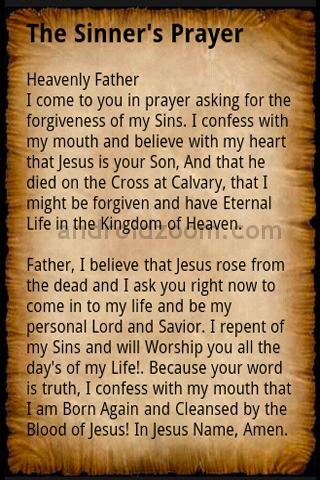
Is the Sinner's Prayer biblical or not? by Tony Miano and Matt Slick


Is the sinner's prayer biblical?  Yes and no.  It is biblical for a sinner to pray to Jesus to forgive him of his sins.  It is not biblical to say someone is saved "because of reciting the Sinner's Prayer".  It is biblical to confess one's sins and ask for forgiveness and put trust, hope, and faith in Christ and his sacrifice on the cross. But, again, it is not biblical to give someone assurance of salvation based on reciting a prayer - on simply saying the words. Salvation is the work of God and the manifestation of that work is sometimes seen in people publicly confessing, even publicly praying to receive Christ as Savior.

So, we want to be clear that elements of the sinners prayer are biblical. However, we also want to be very clear that a person is not saved "because he prayed a prayer". Faith, assurance, and hope should never be placed in the prayer. Instead, faith, assurance, and hope should be placed in Christ via the proper presentation of the saving message which consists of presenting the Law (that we are sinners before God and deserve judgment) and the gospel (that only through faith and trust in what Christ has done on the cross where he bore our sins and died with them can we be saved from God's righteous judgment).  People must repent of their sins and believe the gospel.  That is what the Bible says.

Mark 1:15, "The time is fulfilled, and the kingdom of God is at hand; repent and believe in the gospel.”

1 Corinthians 15:1-4, "Now I make known to you, brethren, the gospel which I preached to you, which also you received, in which also you stand, 2 by which also you are saved, if you hold fast the word which I preached to you, unless you believed in vain. 3 For I delivered to you as of first importance what I also received, that Christ died for our sins according to the Scriptures, 4 and that He was buried, and that He was raised on the third day according to the Scriptures."
Acts 16:30, "and after he brought them out, he said, “Sirs, what must I do to be saved?”  31 And they said, “Believe in the Lord Jesus, and you shall be saved, you and your household."

What we are not saying about the Sinner’s Prayer

Many Christians have a prayer of repentance and faith as part of their conversion testimony. We know there are genuine, Christ-loving, born-again followers of Jesus Christ who will forever testify that someone shared the gospel with them and asked them to repeat a prayer, which they did, and they were saved. This article should in no way be interpreted or construed as an effort to bring into question one’s salvation because he “prayed a prayer.”

That being said, no one is saved because they “prayed a prayer.”  It is not reciting a phrase or the words of a prayer that saves anyone.   We are against formula salvation.  Those whom God sovereignly chooses to save (1 Peter 1:3; 2 Thess. 2:13) and draw to Himself (John 6:44) may pray a prayer - on their own or at someone else’s urging - as part of the first fruits of their salvation.

While there are many Christians who will testify, to the glory of God, that they prayed a “Sinner’s Prayer” the day God saved them.  But there are also people in the world who, as a result of being led in a false “Sinner’s Prayer,” are now apostate, they were false converts (Hebrews 6:4-6; 10:26-31). They have turned their back on Christ and have left the faith they thought they had, because they had never really come to genuine repentance and faith in Christ. They are and were false converts because they put their hope of salvation in "saying words", in "reciting a prayer", in "doing the christian prayer thing", instead of truly trusting Christ to forgive them of their sins against God.

The purpose of this article is not to discourage genuine Christians or cause them to question the authenticity of their faith because their conversion story includes a “Sinner’s Prayer.” Many people have truly been saved along with saying the Sinner's Prayer.  Rather, the purpose of this article is to warn Christians, to plead with Christians to preach the gosple biblically and if/when a person wants to trust in Christ and receive him as Savior, that it is done properly.

A Familiar Story: Sinner’s Prayer Evangelism

"So, do you understand what I've shared with you?"
"Yes."
"Is there any reason why you wouldn't want to receive Jesus as your Lord and Savior, right now?"
"Umm. No. I guess not."
"Great. Then just pray this prayer after me. There's nothing magical about the words. What matters is the condition of your heart."
"Out loud?"
"Yes. Jesus said if you confess me before men I will confess you before my Father."
"Right here? Right now?"
"Well, it's up to you, of course. But what could be more important than making sure you're right with God. After all, tomorrow isn't promised to anyone."
"Okay."
"Great! Just pray this prayer after me. Lord Jesus..."
"Lord Jesus..."
"I know I'm a sinner..."
"I want my sins forgiven..."
"I don't want to spend eternity in Hell..."
"I want to be in Heaven with you..."
"Please forgive me..."
"Come into my life..."
"Save me..."
"Save me..."
"Make me a new creature..."
"Be my Lord and Savior..."
"In Jesus' name, I pray..."
"Amen."
"Amen."
"Praise God! Welcome to the family, brother!"
"Thanks."

"Now, it's real important you start reading your Bible and praying every day. And you've got to start going to church. You need to be around other believers. You need to be discipled. You need to begin the life-long process of growing in your faith. And I'm here to help in any way I can."
"Okay."

Please not that we have underlined those parts of the prayer that are biblical. So, there are biblical elements to the sinners prayer but it is not the sinners prayer itself it saves and again, it must be made clear that it is not reciting the prayer that saves anyone.

It happens thousands of times every day around the world. It happens in one-to-one conversations between friends, relatives, and even strangers. It happens in pastors' offices. It happens via email. It happens in online chat rooms. A well-intentioned Christian shares the gospel with someone (hopefully a gospel that is consistent with the Word of God). The listener seems to understand and even seems emotionally moved by the conversation. The Christian, with eagerness and sincerity, asks the person if he wants to know Jesus as his personal Savior. If the other person responds favorably, then the Christian leads him in a "Sinner's Prayer."

The Sinner's Prayer, False Conversion, and Tradition

This is important.  Many Christians make the cataclysmic and unbiblical mistake of giving the other person a false sense of assurance of salvation, by asserting the person is saved because he prayed a prayer. So, many people walk away from such a conversation still dead in their sins, but believing what they've been told. "I believed what my friend told me, and I prayed a prayer. So, now I'm a Christian!"

It is unbiblical confidence in the "Sinner's Prayer" (instead of repentance and trust in Christ) that often leaves me thinking American Evangelicalism is much closer to Rome than she realizes. The reason is that like the apostate Roman Catholic Church, which holds up church tradition as equal or superior to the Word of God, American Evangelicalism sometimes does the same with her own traditions.

The "Sinner's Prayer" is a case in point.

My presupposition regarding it is an easy one to articulate. Simply put...

There is not a single verse or passage in Scripture, whether in a narrative account or in prescriptive or descriptive texts, regarding the use of a “Sinner’s Prayer” in evangelism. Not one.

However, proponents of the use of the "Sinner's Prayer" will cite several verses/passages of Scripture in a failed attempt to support the unbiblical practice. Here are several:

Matthew 7:7, "Ask, and it shall be given to you; seek, and you shall find; knock, and it shall be opened to you."

Luke 18:10-14, " “Two men went up into the temple to pray, one a Pharisee, and the other a tax-gatherer. 11 “The Pharisee stood and was praying thus to himself, ‘God, I thank Thee that I am not like other people: swindlers, unjust, adulterers, or even like this tax-gatherer. 12 ‘I fast twice a week; I pay tithes of all that I get.’ 13 “But the tax-gatherer, standing some distance away, was even unwilling to lift up his eyes to heaven, but was beating his breast, saying, ‘God, be merciful to me, the sinner!’ 14 “I tell you, this man went down to his house justified rather than the other; for everyone who exalts himself shall be humbled, but he who humbles himself shall be exalted."

Romans 10:9-10, "that if you confess with your mouth Jesus as Lord, and believe in your heart that God raised Him from the dead, you shall be saved; 10 for with the heart man believes, resulting in righteousness, and with the mouth he confesses, resulting in salvation."

1 John 1:9, "If we confess our sins, He is faithful and righteous to forgive us our sins and to cleanse us from all unrighteousness."

Revelation 3:20, "‘Behold, I stand at the door and knock; if anyone hears My voice and opens the door, I will come in to him, and will dine with him, and he with Me."


A brief exposition of each of the above texts will show they should not be used to support the practice of the "Sinner's Prayer."

Continue reading: Does Matthew 7:7 support the Sinner’s Prayer?

The Sinner's Prayer: "Modern apostasy and false teaching that prevents men from being saved."


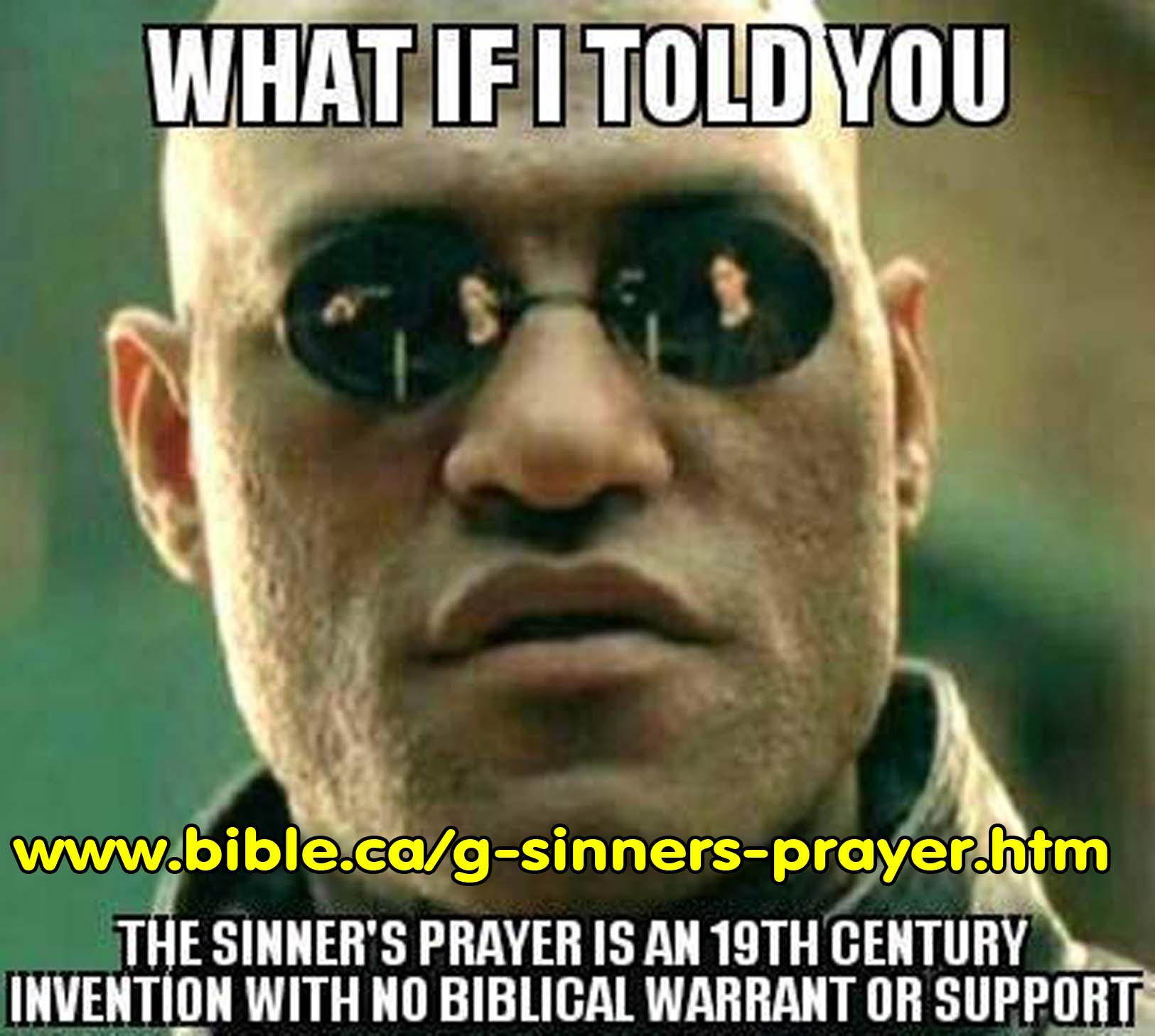
The earliest notion of sinners prayer is less than 500 years old. It wasn't formalized as a theology until around the time of Billy Graham.

No one in the Bible ever prayed for their initial salvation. They did however believe, repent, confess Jesus and be immersed in water for the forgiveness of their sins. The sinners prayer is a an innovation that thwarts God's plan of salvation.

1.      First they replaced believers baptism by immersion with infant baptism by sprinkling.


2.      Second they later replaced baptism altogether with the "sinners prayer" so that baptism is no longer even part of the plan of salvation. If you prayed the "sinners prayer" for your salvation, you are still lost in your sins, because it is not what God said to do.

C.S. Lewis used the term "a great cataract of nonsense" to describe how people use a modern idea to construe Bible theology. One such example, perhaps the best example, is a conversion method called the Sinner's Prayer. It is more popularly known as the Four Spiritual Laws.

Lewis used this term to describe what happens when someone looks backward at the Bible based only on what he or she has known. Instead, an evangelical should first discern conversion practices from Scriptures and then consider the topic in light of two thousand years of other thinkers. As it is, a novel technique popularized through recent revivals has replaced the biblically sound practice.

Today, hundreds of millions hold to a belief system and salvation practice that no one had ever held until relatively recently. The notion that one can pray Jesus into his or her heart and that baptism is merely an outward sign are actually late developments. The prayer itself dates to the Billy Sunday era; however, the basis for talking in prayer for salvation goes back a few hundred years.

Consider the following appeal:

"Just accept Christ into your heart through prayer and he'll receive you. It doesn't matter what church you belong to or if you ever do good works. You'll be born again at the moment you receive Christ. He's at the door knocking. You don't even have to change bad habits, just trust Christ as Savior. God loves you and forgives you unconditionally. Anyone out there can be saved if they ... Accept Christ, now! Let us pray for Christ to now come into your heart."

Sound familiar? This method of conversion has had far-reaching effects worldwide as many have claimed this as the basis for their salvation. Yet, what is the historical significance of this conversion? How did the process of rebirth, which Jesus spoke of in John 3, evolve into praying him into one's heart? I believe it was an error germinating shortly after the Reformation, which eventually caused great ruin and dismay in Christendom. By supplying a brief documentation of its short, historical development, I hope to show how this error has served as "a great cataract of nonsense".

The Reformation 
Although things weren't ideal after the Reformation, for the first time in over a thousand years the general populace was reading the Scriptures. By the early 1600s, one hundred years after the Reformation was initiated, there were various branches of European Christendom that followed national lines. 

For instance, Germans followed Martin Luther. There were also Calvinists (Presbyterian), the Church of England (Episcopalian), various branches of Anabaptists and, of course, the Roman church (Catholics). Most of these groups were trying to revive the waning faith of their already traditionalized denominations. However, a consensus had not been reached on issues like rebirth, baptism or salvation--even between Protestants.

The majority still held to the validity of infant baptism even though they disagreed on its significance. Preachers tended to minimize baptism because people hid their lack of commitment behind sayings like "I am a baptized Lutheran and that's that." The influence of the preachers eventually led to the popular notion that one was forgiven at infant baptism but not yet reborn.

Most Protestants were confused or ambivalent about the connection between rebirth and forgiveness.

Continue reading: The Sinner's Prayer